
museletter ⟠ perspectival acuity
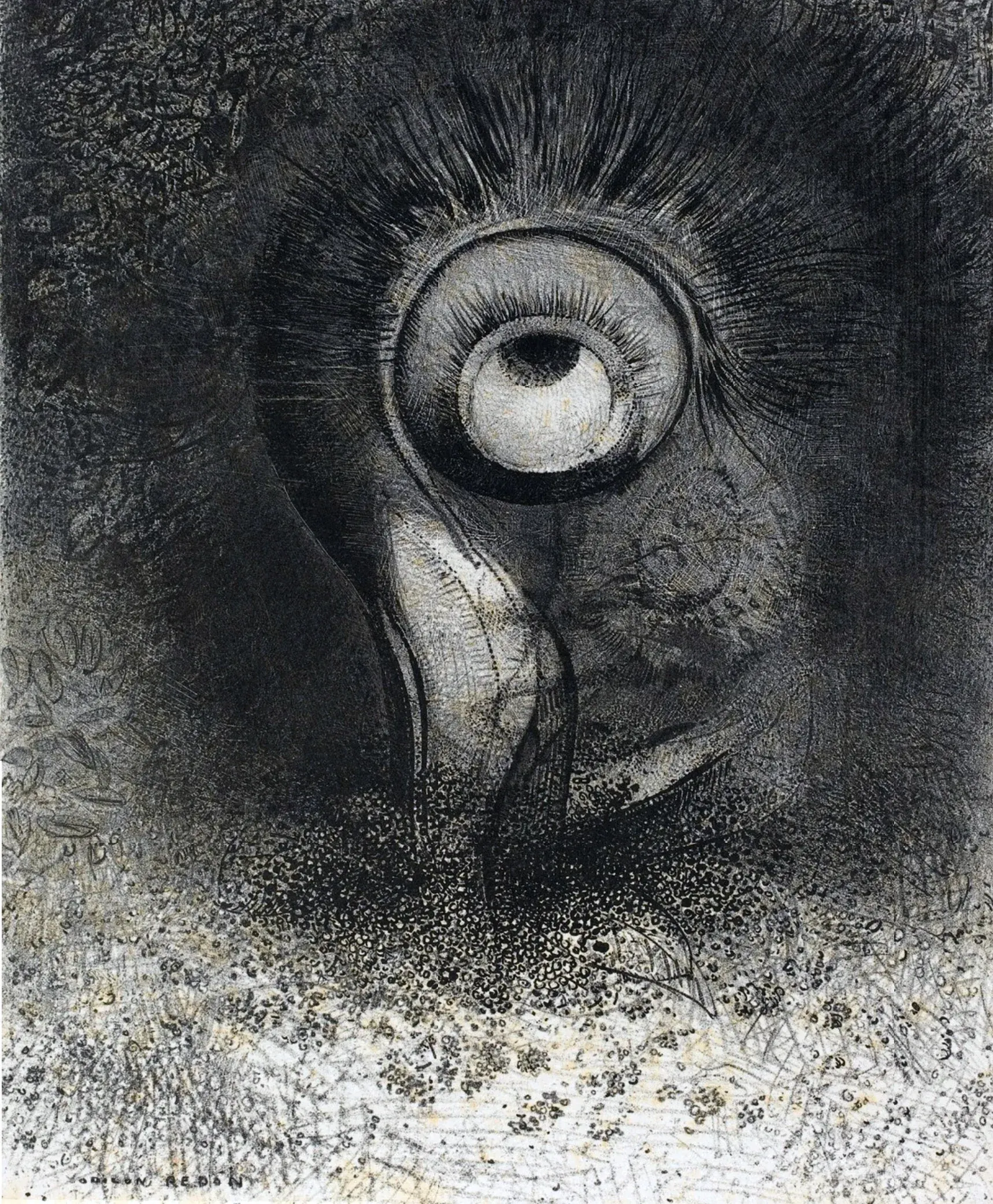
There are conceptual phenomena our minds struggle to hold and contend with. When we encounter the following, our automatic (that is, default and unconscious) reaction is to either (i) glaze or gloss over and lose focus, (ii) dismiss, or (iii) recoil.
- big numbers & exponentials
- dissonance
- hyperobjects
- non-linear and nth-order effects
- voids and antimemes
- paradox
- incoherence
We shall return to these in due course. This is a prelude to a deeper point about perspectival acuity, and cultivating “an acuity for anomaly”—which is a key element of what I like to call “Wyrd Work.”
But the main point of this museletter is, in fact, to say—
“Friends! I have rekindled my podcast—it’s called Wyrd Work with Dr Fox. It’s a podcast for liminal agents, complexity practitioners, and all who quest.
It’s taken me a long while to get here. Since the last episode of season one—wherein I shared Knowledge of Curses—I have had quite a few ‘ludes.’ First was A Poetic Interlude, then came A Prelude to Wyrd Work, then I shared some Lude Words, then a trailer for Wyrd Work with Dr Fox, and then (finally!) the first episode: ‘What is Wyrd Work?’
There’s a warmth and wend and richness and depth to podcasts—magic I intend to share with you in the coming weeks, months, years and days. It’d be wonderful for you to subscribe via Apple, Spotify, or directly via RSS.
If you have been following my work for some time, a kind review on Apple Podcasts would be very encouraging (and will help others find the podcast, too).
I have this wild pipe dream in which I dare to believe that at least 97 folk might invest a few seconds to give it a five-star review. Or even a minute or two to write a review. That’d equate to ~1% of those who subscribe to The Museletter. Could that be you? I’d love to think so!”
—except when do I ever make the main point directly? Perish the thought.
Wyrd Work could be described in two words as “oblique quickening,” and I intend to live the message.
And so—once again—WE WEND.
Perspectival acuity
I’d like for you to attune to your own “perspectival acuity”* in this moment. Sense, if you can, the quality of your attention; the texture of it. What do you notice?
* By “perspectival acuity” I am referring to the sharpness with which we perceive, distinguish, and move between perspectives. It involves noticing which perspective you’re currently in, seeing what that perspective brings into focus (and what it hides), and sensing as to how the same situation might look and matter differently, from other perspectives.
There are many ways to “see” perspective. One is relational: we can meet the world as I (from within), as Thou (in encounter with another presence, human or otherwise), or as It (as an object to be observed). Another is developmental. In Terri O’Fallon's STAGES model, each new “person-perspective” lets us see the previous one as a perspective. Second-person perspective lets me see through your eyes; third-person perspective lets me stand outside us both; fourth-person perspective reveals that even this “objective” view is situated in a context.
Having at least some level of perspectival acuity can vastly enhance the quality of your attention.
Attention is key
—to magic. And wyrd work. Life, too.
Yet there is so much that glimmers and beckons and jostles for our attention. Not all that glitters is gold, and not all that gleams salient is relevant. The key is in our ability to distinguish amidst it all.
In-betwixt the noticing—and the conscious “noticing of your noticing”—is a window; a flicker of an opportunity; a chance to subvert your own machine-like automaticity, so that you might more consciously choose what you devote your attention to, and how.
We experience many such opportunities throughout every waking moment, and it is of course unlikely we can attend to all. But we can train and develop our perspectival acuity—along with our ability to attune and sense into the field—which, in doing so, will expand the options and affordances available to us.
Without perspectival acuity, we don’t notice the perspective that shapes what we notice (and what we don’t), and so we don’t see the options available to us. This, in turn, makes it very likely that we will default to, well, our defaults—the options chosen automatically, in the absence of perceived alternatives.
But the alternatives are there. They always are.
The question is—can you see them?
An acuity for anomaly
In recording the first episode of the new season of the podcast, I—in a very long-winded way—attempt to answer the question: What is Wyrd Work?
Honestly, I don’t think I did a good job. Part of the tragic wonder of magic is that much of it is “non-linear phenomena operating at an order of complexity beyond our ken,” to quote myself. There’s always-already so much more at play than can be eloquently translated and conveyed via speech. At least, that’s the experience for me. But this is all a work in progress, and so I shall endeavour nonetheless.
A key part of wyrd work is in the cultivation of “an acuity for anomaly”—the perspicacity to recognise weak/peripheral/weird signals when they emerge. Glimmers that suggest something else might be at play. The (possibly viable) options that embeckon.
The working (incomplete, draft) description I have for wyrd work is currently as thus:
Wyrd work involves deftly cultivating and perturbing the underlying conditions of an entangled system, so as to quicken and catalyse emergence, development and change. It is how we participate in the shaping of that which is to become.
“Oblique quickening,” as I mentioned, is a shorthand descriptor for wyrd work.
A quickening is the rapid development and realisation of latent potential. It is where life first becomes perceptible.
There is no consensus definition of what life is.* I sense “precarious autopoiesis” plays a part. And nebulous-yet-patterned and intermittently continuous mythopoiesis, too. Also, “to bring something to life”—in the sense that we might bring an idea to life, or bring a team to life—means to enliven and elevate an existing system towards metastability at a higher order of complexity. In other words, there is a greater “richness” at play. “Increase” that holds. To bring something to life is to quicken it.
* I have a book from an exhibition I attended in Stockholm a decade ago titled “Life Itself. On the question of what it essentially is; its materialities, its characteristics, considering that attempts to answer this question by occidental sciences and philosophies have proven unsatisfactory.” Yes, that’s the title. And also each letter of the title forms the structure of the contents. It’s a fantastic book.
But I’ve found we can only approach quickening (and epiphany) with surreptitious obliquity. It’s akin to when James P. Carse says “Whoever must play cannot play.” A quickening cannot be forced. All we can do is tend to the underlying conditions. This is wyrd work.
Wyrd Work with Dr Fox
So I have a new podcast (season). It’s called Wyrd Work with Dr Fox and it might be something you enjoy.
WIT, WISDOM & WILES for living and leading in a time betwixt worlds—a podcast exploring the wyrd work of shaping ‘that which is to become.’
Hosted by Dr Jason Fox (Hall of Fame speaker, author, wizard, rogue), each episode draws upon a bricolage of developmental, mythopoetic and more-than-rational sensibilities, offering practical wisdom and cunning for liminal agents, complexity practitioners—and all who quest for a world more curious and kind (and a future less grim).
Themes of power, myth and magic wend through much of this work.
Perhaps you are ready?
I’m not sure most are ready for this—but I’d like to help more of us be so. As I say in the trailer—this podcast is not for everyone; but it might be for you.
In the next episode, we shall unpack what a “liminal agent” is. These are the folks I love to work with and for. Those of us who express some kind of agency in this time between worlds.
But let me close a loop.
Slippery concepts
Carl Jung is oft quoted* as saying something like this:
“Until you make the unconscious conscious, it will direct your life and you will call it fate.”
* Note that this doesn’t mean he actually said it. But it doesn’t really matter for our purposes.
I am hesitant to use words like “fate,” as Western society has coded that word to be something akin to predetermined “destiny”—and I don’t want to give “End Times Fascism” enthusiasts more fodder. Hence my fondness for wyrd—it is both weird and congruent with emergentism and an orientation toward the adjacent-possible. Wyrd work avoids the perils of both eternalism (fixed meaning) and nihilism (meaninglessness), as David Chapman articulates. ‘There is no meaning’ is the meaning nihilists make, hoho.
Hesitations aside, our lack of conscious awareness of some things does mean that they will continue to influence our lives. Heck, they will continue to direct our lives even with the knowing. But the knowing may allow you to better find and “feed the leaks.”
Let’s return to those slippery concepts.
Big numbers & exponentials
In the 2019–20 Black Summer bushfires, an estimated 60,000 koalas were killed, injured, or displaced. The images were heartbreaking.
I am the kind of guy who is incredibly moved by images and videos and stories of folks rallying to save wildlife and any animal in peril. My partner, Kim, volunteers as a vet for wildlife rescue. I can’t imagine how anyone wouldn’t be moved by the scene of any living being in pain.
And yet, at the same time, land clearing in Queensland and New South Wales is estimated to kill around 1,200 koalas a year: roughly three a day (this is from a 2024 report by Greenpeace and RSPCA Queensland, so watch out—they have an agenda for a liveable planet and better animal welfare). A year-long cross-party inquiry published in 2020 found that koalas will become extinct in NSW before 2050 (unless there is urgent government intervention to prevent habitat loss, which was identified as the biggest threat). It named clearing for agriculture, development, mining and forestry as the main causes of loss and fragmentation.
And in general, the Intergovernmental Science-Policy Platform on Biodiversity and Ecosystem Services (IPBES) Global Assessment (published in 2019) found that around a million animal and plant species are threatened with extinction, many within decades, unless the drivers of biodiversity loss are reduced. This was well before the AI race began driving demand for new data centres, and the (fossil) energy to power them.
Now... what did your mind just do when you encountered all of these big numbers? Did you either (i) glaze or gloss over and lose focus, (ii) dismiss, or (iii) recoil? Or were you able to stay critically engaged? And were you able to maintain your perspectival acuity throughout?
I won’t go into as much depth with the remaining items—but you get the idea. This is hard! Our minds struggle to comprehend large numbers—and especially exponential trends (which we tend to reduce to something more linear). And yet these forces are very much shaping the fabric of our shared existence.
Dissonance
Ah, cognitive dissonance. This is the worst.
This is where two commitments can’t both hold, and so we seek the suspiciously swift relief of a justification.
Even I, who care immensely about Life—about animals and ecosystems and all of our natural world—even I still eat meat, I am ashamed to say. And my heart and mind recoil at the discomfort of confronting this dissonance, conjuring excuse after excuse. It is genuinely something I seek to amend in this life.
Hyperobjects
This is Timothy Morton’s term for things so vast in time and space that we only ever meet them in local glimmers. Climate change, the proliferation of plastics, or PFAS (forever chemicals) are a few examples of hyperobjects. The cleanup of PFAS is estimated to cost up to €2 trillion over 20 years. Will it happen? Not likely—because “the superorganism” (Nate Hagens’s term for the hyperobject we are all substrate to) is seemingly blind to this.
Non-linear and nth-order effects
Here we explore “the consequences of consequences,” which is a very wyrd thing. But our attention often drops after the first link.
This became particularly apparent to me over 15 years ago, in the days when “gamification” was the emergent buzzword. A popular example at the time was the award-winning idea of “speed camera lottery,” wherein if you were caught speeding you’d be issued a fine. But if you were obeying the speed limit you’d get entered into a pot where you had a chance of winning some of the money collected via the infringement notices.
Seems great, right? For the first-order effect, sure: speeds would drop.
But let’s imagine the second, third, nth-order effects. Let’s say this speed camera lotto thing was placed near a school zone. Naturally, reducing car speed near schools is desirable, right? We don’t want kids to get hurt.
But then if there’s a chance to win money by driving in an area... wouldn’t a second-order effect be that there is more traffic and thus congestion (and thus frustration and pollution and risk) in that area? And wouldn’t a third-order effect be that the financial incentive displaces the intrinsic motivation to drive safely around children? And would that also result in greater speeds elsewhere where there is no chance of winning any money?
Traffic and urban planning are complex systems governed by complicated rules. Most of us cannot readily perceive the second or nth-order effects of what we do. Many executives and consulting firms build careers off the back of first-order effects. What we don’t see is the mess left in their wake.
Voids and antimemes
I wrote and spoke of void hunting a while ago. It’s a key element in the development of antifragile and differentiated “strategy.” Yet, in my experience, very few have the aptitude and appetite for it. This is where we come back to noticing what we don’t notice. Seeing absence, or void.
I’ve personally come to learn that once you start making links between environment and social justice and g▩▩▩▩▩▩e and laws and freedoms and power then, well—you become much more aware of the powers at play. And the hazards of sharing what you see.
A couple of months ago Nate Hagens shared an episode titled “When Truth Becomes Hazardous: Navigating Information Through the Metacrisis.” Here Nate aptly articulates the myriad risks that arise from disseminating true information. The point isn’t to withhold true information, but to share it with—as I like to think of it—wit, wisdom and wiles. There’s a magician-trickster canniness required if we are to coordinate effectively in these times. And it takes a diversity of roles.
And, as I mentioned in my piece on void hunting, there is also much information that is actively suppressed. Interval News is one outlet that tracks this (and Ground News does a good job of highlighting the vested interests and biases behind the stories we read).
Also: notice how I didn’t even talk about antimemes? That’s how they work.
Can you see the voids?
Paradox
Our minds can struggle to hold two conflicting truths at once. Staying in the generative tension and alchemy of paradox is key to wyrd work. Metamodernism is a philosophical disposition that allows for this to be done well, oscillating betwixt polarities such as sincerity and irony, futurism and nostalgia, idealism and pragmatism, and so on. But the result is often enigmatic and “hard to pin down.” I myself struggle to describe what I do, because I do not wish to be boxed; being collapsed into an either-or, this-or-that category collapses the generative field. The aliveness is found in paradox; but the colonisers and optimisers want to reduce everything to what fits in a box.
Incoherence
I’ve oft said that true thought leadership is alien. If something makes immediate sense to you, then, well, it isn’t thought leadership, is it? It’s just familiar truths repackaged and handed back to you.
Folks love the familiar, though. (As do I.) We all want to feel valid, and to have our world view affirmed. (Verily!) And so when something doesn’t make immediate sense, we either impose our own sense—or we dismiss it, or ignore it and look away.
As a wizard, I have had to train myself to overcome my rational automaticity. And in a future episode of Wyrd Work with Dr Fox we will be exploring the more-than-rational sensibilities apt for quickening magics.
The mind that is not baffled is not employed.
The impeded stream is the one that sings.
All’s well that wends well
There’s some nomenclature coalescing here—but it will take a few more episodes yet for the conceptual constellation to reveal itself.
In the next episode of Wyrd Work with Dr Fox we shall explore what it means to be a “liminal agent.” Being a liminal agent doesn’t mean spending all of our time in the liminal. We may collectively be living in a time betwixt worlds, sure—but in our everyday lives, we oscillate.
There is richness to be found in the in-between—but it must be brought back to the village and worked into the relational fabric and field. One can easily become lost in the liminal (I was, for quite some time)(I kinda love it). I was once upon a time lost in Labyrinths of Reason, too (that was fun, at the time). But really, we must keep our wits about us.
Thank you for reading, and for sharing with people you love.
And, in the meantime, try to notice what you notice. Cultivate thy perspectival acuity, and let’s see what blossoms.
Much warmth,
Jason
Member discussion