
museletter ⟠ a poetic interlude
Ahoy friends, this is a wyrd poetic interlude to my museletter. I have a few items of news and such, which I shall tuck away towards the end of this epistle. Thanks for being with me.
Interlude! I like this word, very much. There’s a part of my mind—a part I can’t switch off, only hush—that can’t help but make paronomasia-like allusions to such.
“Interlude? Yeah I’m into lewd,” I directly allude.
It’s unfortunate; I do this too often. Can’t help myself.
Words are spells, you see. Each word (spelled out via a sequence of letters; ‘glyphs’ in typographic/arcane speak) evokes a kind of meaning. String together a bunch of words and lo! we have a sentence. But at the heart of it are words.
And I love words. I say this as someone who is sunsetting The “Choose One Word” Ritual of Becoming (which I have still not yet done, despite speaking of it months ago) so as to make room for something better.
Huh, so wyrd!
Words have power. The power to work with wyrd—something we can know as ‘that which is to become.’
But more aptly, wyrd is closer to the ongoing process of becoming itself—the way all things emerge as a consequence of everything that has happened (and everything that is happening now). Wyrd thus gestures to what is emerging amidst our relational entanglement in this unfurling autopoiesis we share.
My friend Danica Swanson (of Studio Slowcore) recently brought my attention to a book illustration by Arthur Rackham (1924) of The Three Norns who weave/layer/carve the threads of wyrd.
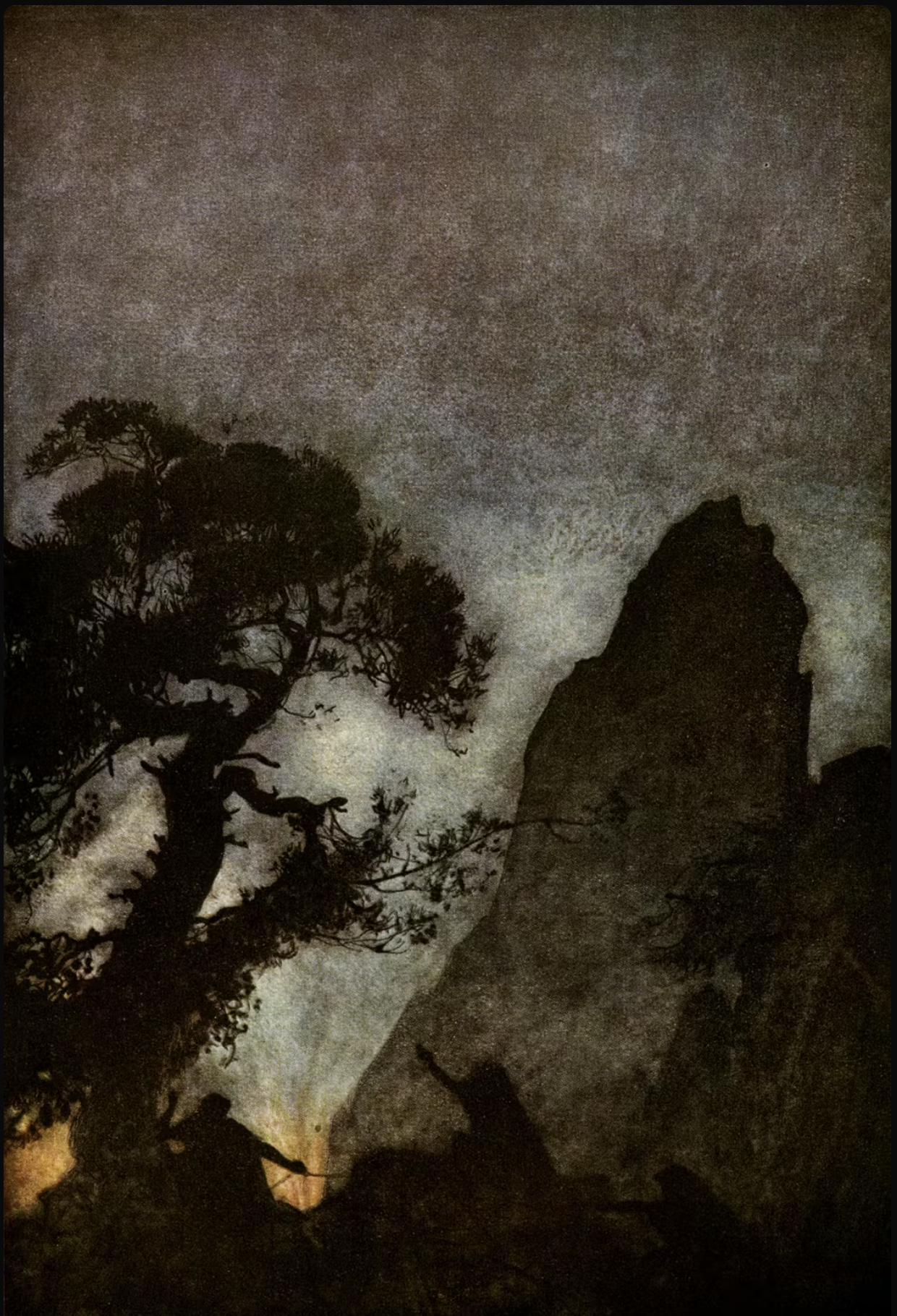
Whilst seemingly synonymous to notions of “fate” and “destiny,” wyrd isn’t predetermined or fixed. It is instead something much more accretive. The Norns—Urð, Verðandi, and Skuld—are actively laying layers that map roughly to what has become, what is becoming, and what is owed (the consequences we must contend with).
Wyrd is a word that can be pronounced in a manner that sounds like how you might say “word” or “weird.” Aye, both are legitimate, and colloquially wyrd is oft used to describe that which is weird or uncanny.
I personally like to affect a kind of pseudo-nordic accent when I speak the word, enunciating it as a blend of both weird and word at once; a slight almost-roll of the “r” that terminates on the “d” that sounds almost like a “t.” Wyrd!
I can get a little carried away with words that sound like other words. But as my dear friend Matthew Stillman might warmly and wryly say—“etymology by sound is not sound etymology.”
Which brings me to the point of this museletter: a poetic interlude!
A conversation with Matthew Stillman
I still intend to write to you of The School of Fox Wizardry, as promised in the last musing. It’s a school wherein I teach you the wit, wisdom and wiles necessary for liminal agents (and genuine ‘thought leaders’) in this time betwixt worlds.
But right now I want to share a podcast conversation with my dear friend Matthew Stillman.
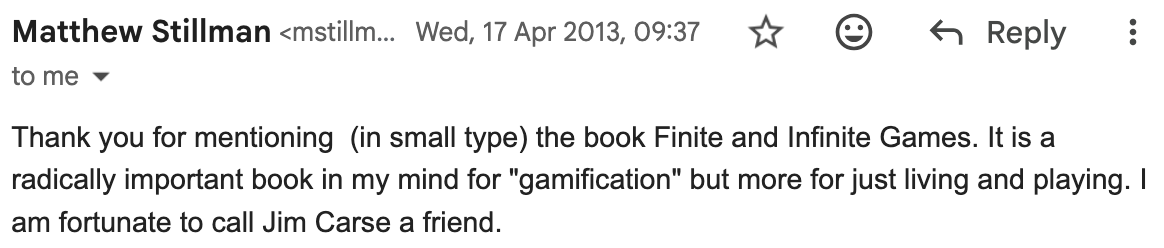
Thirteen (13!) years ago Matthew replied to a museletter post I wrote, wherein I extolled the virtues of Finite and Infinite Games: a vision of life as play and possibility by James P. Carse. This was at a time in which “gamification” was an emergent buzzword. I disliked the finite/mechanical/reductive way that gamification manifested, and was at the time (unsuccessfully) advocating for something more akin to Jane McGonigal’s “gamefulness.” Something that encompassed sensibilities that enabled both finite and infinite play.
The seeds of friendship were planted here and for a decade Matthew and I kept in touch, intermittently. But ~2.5 years ago something catalytic happened, and a wondrous opportunity presented itself. I can’t speak of it directly, but for the past two or so years we have been in almost weekly discussions (along with another friend, Kelly)—something part book club, part poetic kinship (for want of a better term). It has been (and continues to be) one of the highlights of my days.
So! I’m excited to share with you this podcast episode, wherein we talk of James P. Carse, Finite and Infinite Games, and of how one finds their way to poetry. Enjoy!
Poetry, you say?
Why yes, I do.
I’m aware that, to speak of the ‘affect’ of poetry—of its sometimes surprisingly sublime resonance that can catch you completely off-guard, and of the way that the exquisite distillation of aptness can hit you so profoundly (in ways that forever shift your way of relating and being), and of how it can be one of the only sources of solace and succour accessible in the long dark—is a pale and paltry facsimile to the actual affect.
But if you feel drawn to poetry, and if you want to deepen the way in which you relate to it, the way in which you inhabit it, then Matthew has another round of his wondrous introductory course coming up very soon.
Committed to Heart, Committed to Memory (it starts in a few days so if this speaks to you: tarry not).
“When words from verse make their way into the heart, the possibility arises to become a more poetic and beautiful speaker. And then when you see or feel a need arise, those words are there at hand—waiting to aid in expressing what is most true—most beautiful—for you.”
I participated in this course earlier this year—and I heartily recommend it. It is beautiful; vivifying!
Here’s a generous excerpt from a recent post that Matthew shared pertaining to a Theology of Poetry:
“If the word poetry said with a slightly pretentious English accent makes you roll your eyes then I can only imagine that the word theology barked seriously through tweed and pipe smoke might cause a double take with a depleted chin put to chest in response.
If that is true for you then I understand, I think, because poetry and theology have each had manacles clamped on them for a long time. And poetry and theology have been leg ironed and cuffed to two of the most compromised institutions we have – school and houses of worship (pick your favorite flavor) and been forced to serve very particular ends of superiority and silencing while also mostly diverted from a riverrun of joy and relational possibilities. Who could love a mostly disconsolate and cheerless pair like that?
I think that theology (deeply alive discussions and wonderings about understandings regarding the nature of, history of, future of, experience of, practice of/with the divine) is virtually inevitable. Like any spirited friends who are delighted by the mutual sharing and listening and new directions revealed being in dialectic with each other. Not unlike a wander where everyone is facing the same direction on the trail and any path seems like one worth taking together. The destination is uncertain but the manner of travel and the company is the beauty and worth of thing. When theology is directed at opponents with whom we share nothing and don’t desire to share, except to correct or silence, that it falsely asserts its primacy. This is one of the rusted cuffs.”
[continued...]
I love this. Attend to Matthew’s writing and course, if any of this speaks to you.
The School of Fox Wizardry
I know, I know. I keep alluding to it, and there’s only so many months one can do this before patience wears thin. Right now client work has taken me away from cultivating the underlying conditions within the Dark Forest Operating System (DFOS)—“a private internet of protected, member-governed spaces where people can be safe and real together in worlds of their own,” Yancey Strickler writes. “We keep building our identities, audiences, and creative histories on platforms we don't control, hoping this time will be different. It won't be. Because the problem isn't the people running the platforms. It's the architecture.”
Yancey (the chap who created Kickstarter and Metalabel) is someone I have come to trust, for how he has consistently shown up across the years. His work in creating DFOS is very promising, and I have a DFOS space for the “thieves’ guild” I mentioned a while back that’s slowly finding its form.
I don’t believe people ought to pay for community, just as I don’t believe in paywalling writing. I mean, I understand why folk do it, but it doesn’t sit right with my own way of relating to writing (all of my paid membership levels involve access to me—which is a different story).
Besides: community cannot be created; only cultivated—it cannot be “the product.” And as Carse reminds us, whomever must play, cannot play. Likewise, whomever must pay cannot play.
I try not to use the word “community,” anyway. What we are talking of here is a guild for liminal agents, wizards and rogues. Professionals who share a disposition and affinity. And the DFOS isn’t trying to be yet another community platform. The language they use is “groups” and “groupcore.” That works for me. So, “let’s see what emerges,” as those of our ilk oft say.
Doors will be opening “soon,” he says. We’ll know when the time is ripe. “Let him cook,” as they say. Him being me.
Tidbits
Presented in bricolage pell-mell, whilst I have you.
Work-wise...
- I’ve been deep in client work for the past few months—events and offsites for leadership and strategy development. Much of this work is with teams navigating the new possibilities and perils of artificial and agentic intelligence. This may come as a surprise to some readers, given my proclivity over the past few years to warn of the unknown unknowns, unintended consequences, nth-order effects, power laws and multipolar traps. That all remains in place. But there’s a wittedness that the times behoove of us, and I believe that more convivial futures await us still. Ergo: I’m in the midst. I shall share more of this updated disposition soon. There’s a queer hope to be found, if we can somehow view it askance.
- I had the recent delight of appearing on the Esteemed Colleagues podcast with Iolanthe Gabrie. I’ll be keynoting at an event Iolanthe and her partner Yule are hosting for legal professionals in Hobart this midwinter. If you’re a legal professional who is open to new ways of working, come to The Communitas event and let’s have a whisky.
- I’m also keynoting at the Australian HR Institute’s National Convention & Exhibition this year. After a decade-long friendship, this will be the first time that Michael Bungay-Stanier and I share the stage (albeit on different days). He and I are also in the midst of plotting a special side quest again. Last year we hosted a wizardly river walk, replete with cyclonic wind and fallen trees. Who knows what’s next? Stay subscribed to find out.
Life-wise...
- People sometimes ask me “where do you get your ideas from?” This is actually a deeply profound question that evokes enquiry into the domains of wyrd, selfhood, entanglement, situatedness, receptivity, gnosis, acuity and attunement... but I just say: books! Books and walks and time by the river and in the idleness betwixt things.
- I might also say “The Daimon and The Muse,” too—but that’s a tale for another time.
- I’m currently reading Beelzebub’s Tales to His Grandson by Gurdjieff (after having had my appetite whetted by Layman Pascal’s Gurdjieff for A Time Between Worlds). It’s over a thousand pages and I have been warned that it is intentionally both baffling and vexing, that it has ruined people’s lives and that many get to the point where they want to throw the book into the sea. Can’t wait.
- I’ve also been getting into “lore books for video games that don’t exist.” I’m currently enjoying the Vermis series (along with its soundtrack), and I loved this review of Mock Soul. There’s something precious these kinds of books do in awakening more routes back into the imaginal—a domain many of us knew well as children yet veiled ourselves from when we stepped into rationality. It’s good to open the doors again.
- And on that note, I also recently discovered Ribbiting Adventure by Jason Douglas; a delight! Enjoy this hefty preview from the internets (part one, part two « click for the extra images at the end). 🐸
Happy “Full Flower Moon” in Scorpio. 🌝
Warmth,
Jason
Member discussion