
What is Wyrd Work?
Ahoy friends! Welcome to the first episode of “Wyrd Work with Dr Fox”—a brand season of my podcast.
In this first episode I take the opportunity to sketch a (draft) working (incomplete) description for “Wyrd Work.” Here’s the current iteration:
Wyrd work involves deftly cultivating and perturbing the underlying conditions of an entangled system, so as to quicken and catalyse emergence, development and change. It is how we participate in the shaping of that which is to become.
There’s so much to unpack here.
And so, we shall!
⟠ The transcript (lightly edited)
Wyrd Work is something we shall wend with. And—through this wending—we shall accrue enough of the sense and sensibility to better articulate the subtle and more-than-rational deftwerk that goes into making wyrd work work.
More to come, thanks for listening.
00:00 Preamble
Hello friends. Welcome to the first episode of the new season of this podcast, Wyrd Work with Dr Fox. I’m Jason—and I play the role of Dr Fox. And in this season we’re going to be exploring Wyrd Work: the shaping of that which is to become.
Now, this is something I’m an apprentice to. Wyrd itself has emerged as a term that is incredibly apt. It’s congruent with complexity science. It’s congruent with much of the work that I do as a complexity practitioner. And I find it novel, apt and useful in a mythopoetic sense for anyone who is questing between chapters—really, for all of us, as we attempt to navigate this time betwixt worlds.
So let’s get into it, shall we?
That was my first attempt with this wonderful theme music that my friend Mykel Dixon made for me nearly a dozen years ago. I just happened to find it, and it’s perfect for the ushering in of a new season.
I have made several attempts to record this particular episode. I believe this topic of Wyrd Work—and particularly the question “What is Wyrd Work?”—warrants a whole book, and the academic in me—the scholar in me—got very, very excited. The first attempt I recorded was about two hours long, and god, it was wonderful, rich, dense. But too long. Too academic. I then recorded another in which I distilled it down, with some notes in front of me to stay on track instead of wending. But I found it so hampering to have notes in front of me. It really sapped the vitality of the conversation. And so, for this episode, I have no notes in front of me—and therefore whatever I say is subject to change.
But wyrd work behoves some kind of definition. What is wyrd work? It sounds weird, doesn’t it? One of the things I like to say is that it’s weird with a why—as in, with a Y. I don’t know why. I’m of an age where puns really tickle me.
“It’s weird with a why.”
02:33 What does ‘wyrd’ mean?
And in all earnestness, the word weird that we’re familiar with does derive from wyrd. It’s worth spending a moment here.
What does weird mean? Well, it means something that is odd; something that doesn’t seem to fit within our expectations. Sometimes there’s an uncanniness to it, an ethereal or otherworldly quality. Hence my connotations with fae magic, faerie magic. There’s a strangeness to something that is weird.
Weird is unsettling. And when we think about the default mode that most of us operate within, we like to be settled, understandably. We like to be comfortable, we like things to be predictable, we like things to match our expectations. And so when we encounter an incoherence—when something strikes us as odd, when something is strange or unfamiliar, when something stands out—the usual response is to dismiss it, to eschew it, or to double down on whatever we’re doing anyway and put it to the side.
04:08 Complexity and change
And that’s fine for stable eras. Particularly here in Australia, we have enjoyed a period of relative metastability for quite some time. We weathered the financial crisis quite well relative to other countries—though of course there are always second- and third-order effects. The pandemic, too, is something we seemingly weathered well, although it cooked a lot of us, myself slightly included. Hence why I’m doing a podcast on wyrd work and talking about themes of power, myth and magic. I’m not complaining.
But we are in a time betwixt worlds right now. My background is as an academic. I used to lecture at a few universities, and I did my PhD in the School of Environmental Sciences. This was quite a while back—I was only a young scholar in those days—but I spent a lot of time with environmental scientists and ecologists. It was before social media had really taken off; a time in which science and institutions were respected, and expertise was something to be honoured and given heed.
I remember that we had recently been quite effective with the global rallying for the ozone layer: the reduction of chlorofluorocarbons, which of course involved market forces. Once it was economical for the shift to happen, refrigerators weren’t cooled with CFCs, and so we weren’t expanding the hole in the ozone layer. We’ve actually seen it diminish. It’s been a great success story.
And so, when it came to climate change, most of the scientists I knew just thought: well, we just need to assemble the facts. We just need to show people the facts, and reason will prevail, and we’ll start to coordinate effectively. There was the Kyoto Protocol, and Al Gore’s An Inconvenient Truth. I genuinely thought, as a young scientist and researcher in the field, that all we needed to do was provide more facts.
Zoom forward to this year, and we’re opening up new fossil fuel mines. We are doubling down on the industries that are the greatest contributors to greenhouse gases, extinction, biodiversity loss, inequality—lots of things. Everything seems to be going in the wrong direction, despite all the decimals we’ve added to the confidence interval around anthropogenic climate change.
And this is just one factor, of course. Those of you who have been listening to me for some time will know that I had my metacrisis insight cascade, and quite a few years of venturing in the dark forest of my own dissolution—which I’m grateful for, in hindsight. It has led me to a lot of deeper wisdom and genuine magic that I had known of beforehand, yet had occluded because of my proclivity for rational thought. Hence why one of the future episodes is going to be on more-than-rational sensibilities. We don’t abandon rationality, but it behoves augmenting—or at least oscillating away from, from time to time—if we are to expand the field of possibilities and options available to us.
But I get ahead of myself. I guess what I’m saying is that we are in a time betwixt worlds. Climate, society, institutions: a lot of the structures we have relied upon for some time are beginning to crack and fail.
07:13 Attractor basins
Within the field of complexity science, we talk about attractor states, or attractor basins. The late Jim Rutt—rest in peace, buddy—wrote a paper maybe six or seven years ago: In Search of the Fifth Attractor.
Imagine a field in which a marble rolls. It’ll naturally seek out and find the divots. It’ll follow the energy gradient—if there’s any slope, it’ll go there. And if it lands in a basin, a hollow within the field, it’ll stay there. It achieves a kind of metastability. It won’t be moving anymore.
The various basins Jim listed include a descent into anarchy and chaos, a descent into authoritarian dystopia, environmental collapse and so on. It seems like we’re descending into environmental collapse and authoritarian dystopia—but there is a surge, too. There’s got to be a better way.
This sense of metastability is something we have experienced beforehand, and it’s relatively good. It doesn’t mean the dynamics aren’t happening—the dynamics are there—but they’re homeodynamics, held at a metastability, which means that the paradigm we’re operating within prevails. And paradigms are what nest systems, and systems are what nest the activities and behaviours that we do.
One way I like to articulate this time betwixt worlds—and we shall explore this further in the next episode, “What is a liminal agent?”—is this. Have you ever seen a speaker with sand placed atop it, while someone moves through different frequencies? The sand makes these exquisite patterns at different frequencies. It’s really quite beautiful, the harmonics that emerge. The term for this is cymatics.
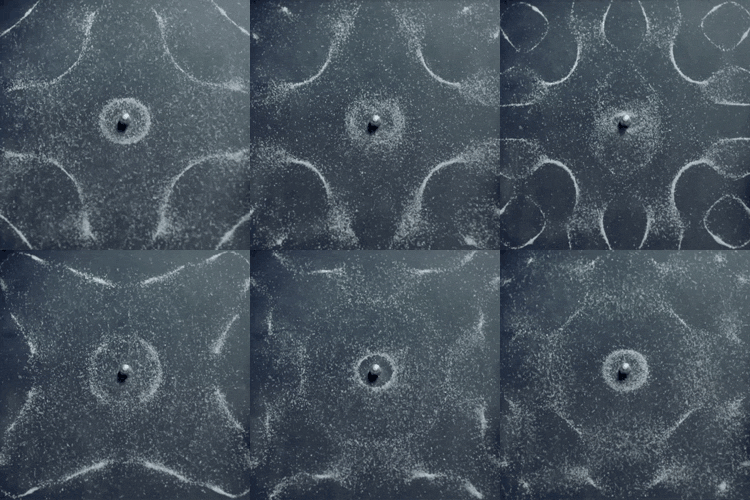
The interesting thing, though, is the phase shift between the different stable shapes that emerge as the frequency changes. In that phase shift, it looks like an unravelling. It looks like chaos. It looks like collapse. [I didn’t conclude this point in the podcast, oops, but here’s what I would have said] But it isn't only collapse. The old pattern has to decompose before a new one can compose—and from within the shift, you can't yet see what shape the sand will settle into. This is where we are: betwixt patterns.
09:43 Our polycrisis and metacrisis
To go back to climate change: climate change is just one facet of the polycrisis. The polycrisis is an articulation of the fact that all the crises we have are interlinked. You can’t really look at one particular thing without looking at the others. Climate impacts food, impacts refugees, impacts societies, economies, inequality and so on.
Then there’s the metacrisis—work I’ve really appreciated from Daniel Schmachtenberger and many other scholars. It sent me on quite the spiral, and I shan’t focus on it too much; we’ll get into the wyrd work itself soon. But the metacrisis looks at the underlying generator functions that give rise to the polycrisis. Why is it that we consistently seem to have different crises about the place? Well, underneath it all there are some common dynamics.
These include rivalrous dynamics, where we compete against each other in a finite game mode, in which people play to win—and in the process of creating winners, you create losers. This is as distinct from the infinite game, which is played for the purpose of continuing the play. Finite players play within boundaries; infinite players play with boundaries. We shall talk about that in a future episode. James P. Carse’s Finite and Infinite Games is one of the most important books in my life.
11:04 Multipolar traps
So we’ve got rivalrous dynamics. And we’ve got multipolar traps.
Think about going to see a music performance. You’ve secured wonderful seats; you can see the stage beautifully—the singer, the drum kit. But as they start performing, the people in front of you stand up to get a better view. So now you can’t see, so you stand up, which means the people behind you have to stand up. Before you know it, everyone is standing—even though if we all sat down, it’d be fine.
Or you’re at a restaurant and you can’t really hear who you’re speaking with, so you raise your voice, and they raise theirs, and the conversation gets louder, which means other people have to speak louder too. Before you know it, everyone is speaking quite loudly at each other. It doesn’t have to be this way, if we all coordinate.
The multipolar trap essentially articulates this: everything would be fine if we all coordinated well together, but as soon as it becomes advantageous for one person to defect, everyone defects. It becomes obligate. In the context of artificial intelligence, for example, it’s a rivalrous, obligate technology. People are pursuing it even though it leads to race dynamics and omni-lose scenarios.
People attribute this to Moloch, the god of coordination failure, child sacrifice and perverse incentives. I like thinking of this as inner-child sacrifice, too. A lot of people sacrifice time and life and their own inner child so as to get what they think they want—but they sacrifice everything they love in the process. It’s a mess. It’s a real mess.
And hence why there are some of us who have had the insight cascade, and who are aware of the cascade of collapses—the Great Simplification, to hat-tip Nate Hagens, or the Great Unravelling, to hat-tip Joanna Macy—or the general sense that enshittification is happening, and that things are not necessarily on an improvement trajectory.
13:21 Viable alternative options
And so the question, then, that some of us start to ask: are there viable alternative options to the default ways of doing things?
This is a question that my book How to Lead a Quest posed when I wrote it, nearly eleven years ago. What is meaningful progress, as distinct from the delusion of progress? Meaningful progress is that which brings us closer to future relevance. And future relevance means that whatever we’re doing makes sense given the context we’re in.
But if we’re honest with ourselves, that gives us a really good opportunity to make the distinction between value—value for everyone—versus profit, which only serves oneself. This distinction between, one might say, vocation and ambition will be a theme throughout this podcast.
There’s a beautiful piece from David Whyte in his book Consolations where he talks about—to borrow Dave Snowden’s term—“the tyranny of the explicit.” The thing that makes ambition work is that it can be so easily explained. But the very cage and trap of ambition is that it can be so easily explained, and what is alive does not want to be diminished by ready explanation.
And so we come to this sense of aliveness; of attunement; of a sense that where we are, and the default ways we’ve been doing things, are not going to serve meaningful progress, or the kind of future that we want for each other, for our children and for future generations. If we are a custodial species—to borrow from Tyson Yunkaporta—are we really doing a good job here?
Now, of course, some Silicon Valley tech bros will say that our role as humans is to usher in the awakening of artificial intelligence—that we are merely the precursor to a new age of artificial intelligence throughout the universe. I’m not of that ilk. I believe that life is incredibly sacred and special, and that to be alive is itself a gift: a chance and an opportunity to participate in something greater than ourselves.
15:36 An acuity for anomaly
And so we come back to wyrd work.
Let’s just go with the normal definition of weird. Synonyms of weird include eccentric, strange, unusual, curious, odd and remarkable. Now think about our context, wherein we are all so busy, so time poor. Many of us are tired; many of us are perpetually distracted. We have an attention-slash-distraction-slash-surveillance-harvesting economy happening right now, where over time people’s attention spans have been groomed to be as fickle as f▩▩k. Pardon me—I try not to swear, but this is one of the things that gets my goat.
Short-form media is knowingly addictive. These companies know what they’re doing; they know the harm they’re doing to young folks. And I would suggest the harm that’s happening in society, too. These technologies that are meant to connect us drive us apart. They increase polarity and division, the proliferation of fake news, outrage bait. It’s got me several times; it really affected me, and it affects many folks. It has really served to perpetuate individualism, and a disconnection from each other, from the fabric of community, and from our interrelationship with life itself.
And so people’s attention spans have been whittled down. When you are busy, distracted and time poor, it’s natural that you’ll tend to favour quick fixes, familiar solutions and default ways of doing things. This default automaticity—the automatic choosing of default options in the absence of viable alternatives—is the machine mode that Gurdjieff of the Fourth Way would articulate. It’s the unquestioned automaticity around how we go about life.
And part of wyrd is the intentional working with fate. I’ll get into this in a little bit—and I don’t mean fate in a predetermined sense. But at the very first step, there’s the recognition that we all have our defaults. And look, we need defaults most of the time—at least eighty percent of the time. But when you’re operating nearly a hundred percent of the time in default mode—where, like a machine, you are simply going about life, busy, reacting to things, in a groove of your own personality, or let’s say a rut of your own personality, with no music, simply doing the things—that is a concern.
For most folks, the weird is something to be dismissed. It’s an inconvenience; a distraction from the efficiency they’ve been groomed to pursue. Many people believe efficiency is an ideal to strive for—and to a degree, it is. The cult of productivity reigns supreme at the moment. And as I said before, many people will sacrifice their time and life energy and everything they love and hold dear on the altar of productivity, so as to get what they think they want. But this cycle doesn’t stop.
The call that I hear, at least—the one I’m responding to, and I think many others share this—is for a shift in consciousness. This game that’s been set up—this finite game, this paradigm in which we need to compete with each other within rivalrous dynamics to get ahead—only leads to omni-lose scenarios, and perhaps the self-termination of our species, to put it mildly, from a metacrisis perspective.
Having said that, it is our context. It’s the domain we need to operate in. And so this requires, as I said at the start, some wit, wisdom and wiles. We cannot escape this, and escape isn’t necessarily the strategy anyway. Simply moving somewhere else and starting a veggie patch on a farm may well be the path for some folks. But we are all entangled. We are in this system together. We cannot not influence each other, nor be influenced by each other. We are only ourselves in relation to each other.
And yet, amongst all this, there are opportunities for us to overcome and override our own automaticity. This is something Gurdjieff talks about, and I love Layman Pascal’s book Gurdjieff for a Time Between Worlds. The “time betwixt worlds” I talk about is a term I borrowed from Zak Stein, whose Education in a Time Between Worlds is a fantastic book. (apologies for Amazon links)
Metamodernism is one of the frameworks many people use to navigate these conversations. We are beyond modernity; we’re still grappling with postmodernity. But people are realising that postmodernity itself, as a philosophical paradigm, doesn’t actually offer any avenues or pathways forward. All it’s doing is critiquing modernity—apt critiques, sure. But we need to start exploring, and start to cultivate that which is to become.
And so we’re back to wyrd: the shaping of that which is to become.
21:06 Weird with a why
I want to come back to this moment of you recognising something as weird. When you sense: that’s odd, that’s strange, that’s peculiar—how curious, what’s going on there? It’s weird with a why. You start to get interested. What’s going on here?
If we start to relate to this mythopoetically, something weird happens. Something within you overrides the default instinct to dismiss or eschew or disregard or explain away. Instead, you lean into the curiosity, and the weird that you experience may lead you to a different range of epiphanies or insights.
Let’s go back to that attractor basin I talked about—the metastability that societies and individuals can find themselves in. It takes a lot to actually get out of an attractor basin. Usually you need a burning platform, or for things to degrade to the point where you have to move. That may be what’s happening on the planet right now. Everything that’s happening—the culmination of these polycrises, as perpetuated by the metacrisis—may be driving a species-wide initiation and awakening, where folks start to override their automaticity, override their selfish, petty, narrow ambitions, and start to respond to a broader, deeper and wider calling.
And so there’s this moment of recognising the weird, and choosing to stay in the tension of the unknown; to develop a deeper relationship with mystery; to flirt, to court, to sense into the unknown. This is what the poet John Keats would refer to as negative capability. I think it needs a better term. But it’s the ability to stay in the tension of unknowing without grasping for ready explanations, without prematurely foreclosing what things could or couldn’t be, without grasping irritably for explanation.
This is a sacred and really special place, and it’s a nice place to start this podcast, Wyrd Work.
23:28 Trickster bricolage
Wyrd with a Y, by the way, refers to the shaping of that which is to become. It derives from Norse mythology: the Norns, the three sisters—very similar to the Moirai—who weave the tapestry and the threads of fate.
I’m working syncretically here. I’m a trickster bricoleur, working with what pieces and fragments I have. Growing up in Australia is an odd thing. I have half-Polish ancestry, and growing up on a land where we don’t have long ancestry or roots means there’s a lot of local lore that I don’t feel I have permission for, nor could I aptly access—although I’m working on that. And so we assemble from the materials that we have, and wyrd is something that really speaks to me.
24:33 Goals blinker focus
It speaks to me because my PhD was in motivation and behaviour change—specifically, looking at the efficacy of goal setting. And the irony of goal-setting research is that almost all of it will show that it works, because it does work. Goal setting works. It does what it says on the tin. The thing we’re not aware of, though, is what isn’t measured: the unintended consequences, the second- and third-order effects.
Goal setting works particularly well within clear, complicated, closed and contained contexts—sports games, the Olympics, a lot of formulaic work with predictable outcomes. These things can be optimised, and much of management philosophy emerged from factory work.
But our world is so entangled right now. New information reshapes our affordances quicker than we can understand it. It’s complex. Much of the work that we do is complex. Even within closed containers we’re working relationally—and humans, like all living beings, are complex. Yet we apply a limited frame to these things, a machine-like approach, which is what folks often do. It’s why productivity remains such a strong topic. Everyone wants to get more sh▩t done, and there’s a place for that.
But when we simply perpetuate the underlying conditions that give rise to the challenges we’re trying to solve, then we’re just optimising our way into oblivion—or at least into a pantomime that leads nowhere.
And so there’s wyrd, and the moment of recognising that there are viable alternative options—or that there may well be viable alternative options—to the default ways of doing things. This is how I articulated questing.
26:21 Missions and quests
Questing, though, had its own challenges. The word quest rightfully refers to a long or arduous journey—non-linear, fraught with peril—in which one works towards a vague or non-specific goal. And the journey itself, the questing itself, is the transformative move.
It’s very different from a mission. A mission works to a very clear objective, usually within very tight time parameters, with a narrow band of what constitutes success and what doesn’t. Goals work like this too. To set a goal, you need to decide—with the limited information you have—what you want to achieve, cast that vision into the future, and then work towards it.
The thing is, with goal setting and with missions, if new information comes to light, that new information is a threat to achieving the goal. So the weird things that occur on the path—the weird beckonings; that’s odd, that’s peculiar, I wonder where that path might lead—we eschew those, because we’ve got sh▩t to do. We’re busy, we’re tired, we’re distracted, and we’ve got to achieve our goals.
And so when everyone thinks like this, in this default automaticity, this machine mode, everyone productively works their way without moving forward. It’s like the Red Queen in Through the Looking-Glass: no matter how fast we run, we don’t get any further. We can put a lot of effort in, and the underlying substrate won’t change. The metacrisis will remain; the polycrisis will persist. No matter what we do, we’re simply dancing the same pantomime. And that’s okay.
28:21 Engaging in wyrd work
But if you want to shift something in your life—if you’ve been working on something and you notice that every time you set a goal, every time you try, it doesn’t seem to work—well, perhaps we need to engage in some wyrd work.
By the way, wyrd has homophones. One is weird, as I said. But it’s also word. You can pronounce wyrd as “weird”, with a slight roll of the R—or as “word”. This is part of the confluence of why the word has such resonance for me.
So wyrd refers to the shaping of that which is to become, and it degraded into weird, which simply articulates something that is odd, uncanny, unfamiliar, peculiar, curious, remarkable.
I’ll often talk about the glimmers in the penumbra. If you’re very good at not looking at the bright light at the centre that everyone else is looking at—like moths to the flame—and if you can attune to the penumbra, letting your eyes adjust to the dark, then you’ll be better equipped to perceive the glimmers: the weird beckonings that take you away from the mainstream, away from the default path, perhaps beckoning you to a quest in which you will transform as a result. And collectively, as a species, it may well be that we find our way to new avenues of meaningful progress.
Meaningful progress, as I said before, is that which brings us closer to future relevance, and future relevance is the state in which our activities make sense given the context we’re in. That’s a very clinical and dry definition.
30:08 A world more curious and kind
The bumper-sticker purpose statement I have for this work, and much of what I do, is to co-create a world more curious and kind, and a future less grim.
Now, if we think about where our world seems to be headed, it seems to be towards a world more certain and cruel, as distinct from curious and kind. We’re seeking much more surveillance, much more monitoring, much more measurement, much more predictability.
And in addition to rivalrous dynamics and multipolar traps, another factor of the metacrisis is power laws. Within any distributed network, power tends to accrue into nodes. Those who have power get more power. Those who have wealth can invest that wealth to get more wealth. Those who have power can use it to shape the laws that protect them and give them more power. This is playing out at a grand scale.
And you and I are but mere players in this wonderful pantomime we share. But perhaps we are playing the infinite game together. Perhaps you and I have the glint of the infinite player. We don’t play to win; we play to continue the play. We don’t play within boundaries; we play with boundaries.
And so we are attuned to wyrd work.
31:35 A ritual of becoming
Now, wyrd work. I love this word, because I love words.
For many, many years I ran a program called the Ritual of Becoming—actually, I called it The “Choose One Word Ritual” of Becoming. It served me very well for about a dozen years as a seasonal moulting, a shedding; a way of staying supple, of being able to shapeshift and not be too shackled to a particular identity or personality. Of not being so ingrained in the machine-like predictability of who I am, and of the stories I share and the narrative I hold. It allows one to move a little easier in one’s own skin, and to shapeshift into whomever one needs to be as the context changes.
I really like The “Choose One Word” Ritual of Becoming. I created a program for it with seventy-plus videos: deep reflection, introspection and projection, a process of self-development culminating in the choosing of one word—one word to cast forth into the future, to serve as a fuzzy contextual beacon for your year ahead. It’s effectively a distillation of all that deep reflection and introspection. If you’re in a rut and you want to get into a new groove, it allows you to make that transition. It’s a program for intentionally navigating the cultivation and development of new aspects of yourself, as befits new chapters of life. It worked really well. I love it.
And yet I noticed myself frustrated, because despite the depth of the program, many people are busy and distracted and don’t really have the time, because of the paradigm we’re operating in. So the tendency is to just pick a word quite quickly. It takes me about three months to choose one word—and then there’s a nine-month period of living the word, and another three months of gestation. And I’ve seen people pick their word in three minutes or less. I say pick because it’s a weird-sounding word. Pick. Flick, tick, ick. It’s just ick. Pick a word.
And inevitably the word seems novel to them, but it’s but a perpetuation of the same automaticity. I’ve seen busy executives—the kind who, when they’re chatting with you, aren’t really a hundred percent there. They’re answering emails in their head; they’re scanning the middle distance to see if there’s anyone more important they need to speak with. And they’ll say, “I’ve got my word. Yep, that was great. My word is accelerate. Accelerate, yeah. I loved what you said about meaningful process.” (I’d said meaningful progress, lol) But they hear what they want to hear, and they choose a word that’s but a mere incremental iteration of their current default automaticity. It struck me as interesting that this was the case.
I’ve since mostly sunsetted the Ritual of Becoming. I’m in the process of moving it to the Skulk, which is our hideaway, school and guild for liminal agents, launching very soon. I’ll be working on a new cohort-based iteration of the Ritual of Becoming, which will span two or three months, I suspect—because the quick fixes, the familiar solutions, the default, iterative, automatic responses aren’t actually serving anyone.
And so I got really interested in words—particularly the quest for the apt word. There have been some brilliant words that have emerged from folks, partly because of the charm of the word itself; the word is a kind of magical incantation. Some of these are f▩▩k-off words. They’re so good. You hear one and think, that’s f▩▩king great, I love it. I shouldn’t swear again—sorry if there are children. But some words are just like: f▩▩k yeah! I love it.
My words have been words like druid and wizard and jester and fool and gentleman and pirate—fairly archetypal words. And I’ve heard some incredible words through the years. But this quest to venture beyond our own defaults has been part of How to Lead a Quest, part of the Ritual of Becoming, and part of my own reflections here. And so wyrd work itself is particularly apt.
36:28 Love thy fate(s)
Back to the three Norns, threading your fate. When we say fate here, we do not mean a predetermined fate. Everything leading to this moment right now—this moment in which you hear me—has been woven into the tapestry of your life. You are here, right now.
And whilst you might dream of being able to do many things—and in Western society in particular we love to dream big and achieve the impossible; nothing is impossible—there is a pragmatic side to this. If you’re a mother or a father with young children in your life, well, sure, you can go off and live your dream of being a solo tango dancer in Spain, or a Silicon Valley sex-bot entrepreneur, or whatever it is. Yeah, sure you can. But realistically, your place is looking after your family, at least for a while.
You have a role—a mythic role. This is why I love what we’ll be looking at in mythic mode. We’re looking at role-playing. Roles are relational. Roles are also patterned responsibilities within the fabric of society. You have a role to play.
So what I’m saying is that the threads have been woven. You are where you are, and there are consequences of what has come before that you need to attend to. That’s okay. This is life.
All of us will die. Life is terminal—or, to quote my friend Kelly Butler, the situation is terminal. Life goes on, thanks to the many deaths that fuel life. But the situation, for all of us, is terminal. The question is: how will we get there?
Many people locked within ambition will choose to arrive at their deaths with quite a few zeros in their bank account, or in ownership of quite a few material possessions—and ownership is something that only exists via social consensus. I think there are better ways to be and to live life, and that is relationally: in response not only to the roles that we have, but also to the beckonings and the callings.
And so this is wise discernment. It’s wit, wisdom and wiles. Wit is an acuity for peripheral connections. Wisdom is the path of least unnecessary suffering. Wiles is having the canny knack to be effective, because we are still mired in this metacrisis we share together. Wit, wisdom and wiles is wyrd work.
So the threads of fate have been woven. You are where you are. There are consequences to attend to, for all of us. But you have choicefulness. Your current situation affords you different things—you have affordances. And there are ways you may orient and enact certain things that open up new affordances.
And so wyrd here is where you work with fate. You work with the Norns. You work with your own fate. You have your amor fati, your love of fate. You love the situation you’re in—which is pretty hard to say, as many people are in pretty grim situations right now, and I don’t want to be dismissive of that. But I want you to have a sense of agency. A sense of: okay, yeah, this sucks. I didn’t expect to lose my job, or to be in a divorce, or to have my limb amputated, or whatever it is. This sucks. What are we to do?
And from that space—there are threads; here we are—comes something almost like acceptance and commitment therapy. All right, here we are. What are we looking for?
This is where we sense into the adjacent possible—another complexity science term. Whilst anything is possible (great), the adjacent possible are the things we’re more likely to be able to do, because we are in closer proximity to them. And so rather than getting swept away with grand visions and goals, we look to and attend to the conditions that we’re in.
We develop an acuity for anomaly, with which we can discern and recognise the weird beckonings, the wyrd. We also deepen into a sense of calling and fate, and destiny and things like that. Destiny’s a funny word too. Gotta be careful with these words.
41:48 Lantern consciousness
This orientation is a way of relating to life that is more than rational; a way that widens the focus.
I saw a film with Kim a couple of days ago—Silent Friend—which involved research on a ginkgo biloba tree. There was a brief little exposé on consciousness, the prevailing theory being that consciousness is like a spotlight: we are conscious of what we pay attention to. And they introduced this notion of lantern consciousness, where instead of a focused spotlight, it’s more of a glowing nimbus—a glowing orb that bounces around different things.
What I’m attempting to do here with wyrd work is to widen the aperture a little, which means you’re better equipped to perceive within the dark. With a wider aperture, you have to be careful not to look at the bright light too much—it’ll hurt your eyes. But I want to widen the field in which you are considering things.
This has been my own journey too. I’ve been quite thinkerly for much of my life. It was only through the dark forest chapter of my own dissolution—about half a decade contending with grief, in the underworlds—that I remembered I have a body.
My favourite quote from the world of Gestalt (Kim’s halfway through her four-year course) is from Fritz Perls: “Lose your mind and come to your senses.” I love it so much. And there’s another: heart-led thinking, full-body sensing. I really love this. Heart-led thinking, instead of head-led thinking. We have been very cerebral. Heart-led thinking doesn’t exclude the head, but it includes the whole body, with the heart leading the thinking. This is the orientation of wyrd work, and we’re going to go into a fair few facets of it.
44:06 Coming to terms
I’m doing the classic thing of coming to terms. When two scholars from different fields meet and converse, there’s usually some attempt to disambiguate, so that we know what we mean when we say certain things. We can hear and understand each other and, through the shared cant—the language betwixt us—arrive at deeper synthesis.
I say cant because I’m a big fan of thieves’ cant: the slang a thieves’ guild will use so that folks can chat with each other even whilst being overheard, and the conversation itself carries a deeper meaning. I love it—but I’m getting carried away again.
So: Wyrd Work. Let me give you an incomplete working description. I’m not going to call it a definition yet. This will grow over time. It’s going to be really fascinating listening back to this episode in years to come.
This is something I feel genuinely called to contribute a body of work for. I haven’t done the memetically fit, commercially wily thing of securing the domain name for wyrd work. I just can’t be bothered with that. I find myself so sapped when having to contend with finite-game antics—though sometimes it makes sense. You’ve got to win some finite games; sometimes it’s part of the infinite play. But I haven’t done any of that.
So many threads of my life have coalesced to be able to offer this perspective for you. My hope is that the podcast—through the various episodes and conversations—will help you, whom I consider to be a fellow liminal agent. If you’re this far into the podcast, you definitely have the knack. You’re a fellow liminal agent. You’re a complexity practitioner. You may have magical sensibilities as well. And you have the questing disposition.
46:17 Wyrd Work – an incomplete description
So here’s a working description. A draft. Incomplete.
Wyrd work involves deftly cultivating and perturbing the underlying conditions of an entangled system, so as to quicken and catalyse emergence, development and change. It is how we participate in the shaping of that which is to become.
There are a few important terms here. I say wyrd work involves: this is non-exclusive. It involves many other things. I’ve talked about Dave Snowden’s apt articulation of attunement, orientation and inscription, and I haven’t really dived into the acuity for anomaly.
But look at the description itself. Wyrd work involves deftly cultivating. What does it mean to be deft? It means there’s an economy of movement. If something is deft, it’s not heavy; it’s not a forced imposition of will. It’s graceful. Think of a thief’s nimble fingers. Deft work is to move quietly and plant things—to hark back to an article I wrote many years ago on solarpunk sensibilities, Move quietly and plant things.
So when I say deftly cultivating, we are attending to the underlying conditions. We’re planting seeds. We’re doing things to the soil that give rise to new conditions. We’re not looking for immediate effect. We are planting things. And most wyrd work is oblique. In a simple sense, wyrd work is an oblique approach to change—maybe I should have just said “working with change obliquely”. But it’s more than that.
Deftly cultivating and perturbing the underlying conditions. Perturb is different from disturb. Our intention is not to disturb or disrupt; those are too big a manoeuvre. To disrupt something is to permanently destabilise its underlying conditions. That’s dramatic. That’s the whole move-fast-and-break-things approach. Disruption was such a big buzzword back in the day, and now we’re dealing with the aftermath of companies that moved fast and broke things, as many facets of society have become broken.
Perturbing is different. To perturb something is to unsettle it a little. Imagine a glass that’s just settled, and you swirl it a little and see what bits are moving. In the group facilitation I do, humour is sometimes a gentle perturbation. It’s not a disruption; I’m not calling someone out. But the humour itself becomes a bit of a sonar ping. You can see where engagement is. And with this little weak probe in the complex system, you can perturb the underlying conditions and notice: that’s interesting. That person looked a little uncomfortable there—I wonder what’s going on. That person looked at the other person there. Hmm, okay.
A little side note here: most of the work I do is wyrd work, but it’s not the work people pay me for. When people hire me for a leadership offsite or a strategy offsite, much of the important work goes into the priming, through the subversive questions I ask so as to reveal the underlying power structures and dynamics already at play. This is done deftly.
Then there’s the priming of the folks who are arriving, via subversive questions and good humour and cheer. And when folks arrive, there’s the intentional effort of making people feel comfortable—warm, welcome, heard, understood. This is what most people gloss over. They get right into it, and so people arrive in their default automaticity: narrow-focused, turf-defending, distracted, tired, busy, time poor, in quick-fix and familiar-solution mode, antagonistic to anything other than the default—and therefore antagonistic to anything weird or uncanny or peculiar or odd. And thus the strategy is, at best, an underwhelming success that simply increments and iterates upon previous work. That is not the recipe for a good strategy offsite.
And so, intentionally, there’s the warmening. Part of the warmening is the dissolving. We’ve got to allow for some settling. We’re not in the liminal yet—we’ll talk about the liminal in the next episode. I love the term; I understand some people don’t. There’s a lot of deftness to being a liminal agent—and part of it is knowing that we don’t spend all of our time in the liminal.
But in an offsite, we make folks comfortable. Yes, there are the official things we need to get through. But it’s the dinner conversations, the emergent responses, the walks we go on, the wending, the humour, the relationality, the connections: it’s the conditions that give rise to epiphany. That is the wyrd work. And that requires deep attunement, ongoing orientation and reorientation, many perturbations and inscriptions, an acuity for anomaly, and a willingness to hold negative capability and stay in the tension longer. It requires psychological safety—but not in a passive way. In a way that we can actually be enlivened, and can actually be risky with each other.
All of that culminates in these conditions—the conditions of an entangled system. Let me go back to the description: wyrd work involves deftly cultivating and perturbing the underlying conditions of an entangled system. (It doesn’t have to be offsites, by the way—that’s just one example.)
Entangled system is the recognition that we are all always already interconnected. We are of, in, for and with complexity. We are an inherent part of the fabric of life. There’s no changing the entanglement. We’re all in this mess together.
56:53 The Quickening
But I love this part of the description: so as to quicken and catalyse emergence, development and change. The quickening. I feel a physiological quickening whenever I say it—a kind of rapid realisation. Quickening refers to the rapid development or realisation of latent or dormant potential.
The important thing about wyrd work is the recognition that already within the system itself—within the entangled interrelationality—lie the wisdom and the answers, or at least the questions, that will give rise to the affordances that move us closer to future relevance and meaningful progress. Nature knows. It’s already there.
You are not the expert arriving with the answers. Expertise makes sense in closed systems, where things may be complicated, sure, but where there is an order to it: an org chart, an architected overlay. If a machine breaks down, you can diagnose what’s wrong with expertise, find the fault, replace the part, and the machine works again.
A complex system, as distinct from a complicated one, is open. It’s living; it’s interrelated; the whole is other than the sum of its parts. And so the approach is different. In these systems, expertise is actually de-privileged—because if you’re bringing expertise, you’re relying upon previous contexts, potentially closed and stable contexts, that may not match the current context we’re in. And if we entwine ego with expertise, there can be a stubbornness and defensiveness to defend one’s expertise, and thus one’s status and standing within a group. That can lead to a further narrowing of the field of possible options, and a likely doubling-down on incremental automaticity, at best.
So when I say wyrd work involves deftly cultivating and perturbing the underlying conditions of an entangled system so as to quicken and catalyse emergence, development and change—the quickening I’m referring to is this: there is already something in the room with us. There is something that exists amidst the inter-relationality we share. And part of our collective role is to create the conditions that quicken and catalyse the emergence of the way forward.
And by development, I mean: how do we move towards metastability at higher orders of complexity? This has been the orientation of the universe ever since the Big Bang. Hydrogen, then helium, then more elements, then molecules—and then, in this very special situation, life emerges on Earth. Phytoplankton. Phytoplankton, photosynthesising with chlorophyll—a molecule with magnesium at its heart. Heme, the molecule that carries oxygen through our blood, is nearly identical to chlorophyll, only with iron at its heart instead. (I might have mangled a causal claim in the podcast, btw—but you get my point). Multicellular organisms came next, and then—well, here we are, listening to this podcast, a whole hour in. Life itself has this orientation towards metastability at higher orders of complexity.
I say metastability because there are always dynamics, always change. But if we zoom back, you can see the nebulosity and pattern: yeah, this is kind of stable. And we’re not in a stable period at the moment. Civilisationally, it is not stable. And so it behoves us to keep our wits about us. We need the wit, wisdom and wiles to be effective liminal agents in this time betwixt worlds.
So, quickening refers to the rapid development or realisation of latent or dormant potential. The quickening is what happens when you have organic matter assembled and suddenly you see the spark of life. The quickening is what happens when you see a foetus’s heartbeat for the first time. It’s a sacred, special, miraculous moment. It’s something I live for, and it’s something we can all collectively participate in. As I say, it is how we participate in the shaping of that which is to become.
Now, as I say, there are already threads that have been laid down for all of us. Carl Jung purportedly said that life begins at forty, and everything before that is research. If you’re younger, forty is, I’m sure, just an arbitrary number. But there’s something to be said for everything you have experienced in life. Everything is leading to this moment right now.
You have choicefulness. You have options. You have many default options, and most of them are great—we need our comfort zones; that’s how we restore ourselves. But there may also be beckonings for you personally, and in the work that you do: odd, uncanny, peculiar, curious, weird beckonings that behove a kind of wyrd work to attend to. An oblique, surreptitious approach to the cultivation of development and change within complex systems. And that’s what this podcast shall explore.
This was an attempt to answer the question: what is Wyrd Work? I’m sure we’ll be layering in more sensibilities as the podcast unfurls. Not every episode will be this length—this was a big one, and I really wanted to share it with you. This is my first time speaking about wyrd work. I’m so excited by the concept. It fascinates me. I feel like it’s infinite—or asymptotic, perhaps, at best. We’ll never fully articulate it. But it’s a wonderful, wonderful disposition to have in life.
So I look forward to sharing more episodes with you. I’ll try not to make a habit of this, but I want to reach a certain threshold: if you happen to enjoy this, a kind review on your favourite podcasting platform will help others find the show. I’m not very good at social media, so any help you can offer to spread the word is greatly appreciated, and a kind review is wonderful for that. If you’d like to keep in touch with my thinking and writing, foxwizard.com is the best place to do so.
Thank you so much for listening. It’s nice to be back in the podcasting game. I look forward to more episodes ahead. In the next episode we shall be exploring: “What is a Liminal Agent?”
I appreciate you. See you for the next episode soon.
Member discussion