
museletter ⟠ blue moon
Friends! I’ve done it again and written a long post—too big for email inboxes. Let me share with ye some links to what’s what. And then I will pontificate upon mirrors, distortions and reflections. It’s also Monday as I write this to you. Moon’s Day—in the afterglow of last night’s blue moon.
Forgive me but this museletter shan’t have the smooth segues you may have come to expect. I do like seamlessly transitioning, pirouetting betwixt points. But I shall instead deploy line-breaks. Jarring, I know. Here comes one now.
Aye, intelligence
The main thing I want to share with you is this: I wrote a piece on Why I’m ‘Helping’ Executive Teams With Agentic AI.
 Dr. Jason Fox
I swear, I haven’t become corrupted by The Machine. It’s just that the times call for some of us to run along with the beast—so that we are better situated to influence the underlying conditions that shape what decisions are made. Oh and also: to enact the role of Trickster, if and as and when it befits the context (if we feel called to).
This piece goes deep-ish into:
- the sublime sensibilities of attunement
- the treacherous narrow path all wizards must walk
- why we must eschew prophecy (or at least regard it with Trickster’s glint)
- dancing with legibility and illegibility, so as to protect imagination and aliveness
- working to co-create a world more curious and kind (and a future less grim)
Long-term readers will know: I am sceptical about AI because of how power works. We seem to be on a fast path towards techno-feudalism, ubiquitous corporate surveillance, corporate fascism, ecological catastrophe and mass extinction—and AI is an accelerant.
And yet! Nothing is set; there may well be a way through this mess yet. Regenerative accelerationism, maybe. I don’t believe it, but I want to! Oh gosh how I want to.
We’re in the storm, now. And I still contend that things will, alas, get much worse before they get better. But I also know: this could be our awakening opportunity. The Great Turning, as Joanna Macy might say.
“pierwszy do wyjścia”
My House Words, as you might know, are “First to Leave” (pierwszy do wyjścia).
These words work in the sense of the Tactical Cowardice™ and strategic cunning (metis) of The Fox. But—only in a localised sense.
Because when I look towards the plausible (probable) spill-on effects of this meta-crisis we share (including—but certainly not limited to—the “geopolitical crisis” > the fuel crisis > the fertiliser crisis > the food crisis, in this, an El Niño year), the question is: first to leave... to where?
Ha, there’s nowhere to go: the predicament is planetary in scale. It’s not local. It’s not a boundaried, finite game. It’s all part of the infinite game, to which you and I and everyone we know are deeply entangled within. And even if you could go to another planet—why on Earth would you want to? You could build a bunker and stockpile food—but who wants hungry neighbours? This is, and will always be, a turn towards relationality. Deep, animate, relationality.
And so my fox-like shenanigans are less about leaving an area of conflict, but rather: leaving the frame within which I view it. (My hope, btw, is that by sharing my inner world with you I might inspire or perturb you enough to reflect generatively upon yours).
Adrian Lambert wrote a fascinating essay earlier this year, exploring the question of how those of us with neurodivergent traits (a quality more than half of my friends seem to have) tend to be better able to sense ‘systemic collapse’ early.
As ecological, energetic, and material limits assert themselves, the problem space transitions from growth to constraint navigation. The relevant queries become how to detect boundary conditions, recognise failure modes, and adapt behaviour under irreversible decline.
In such contexts, traits associated with neurodivergence (system-level pattern recognition, reduced reliance on social validation, and willingness to follow implications to uncomfortable conclusions) become functionally relevant.
I’ve been meaning to share Adrian Lambert’s essay with you since I read it. It puts my own protracted cocoon chapter into some context. What had started with someone close to me getting cancer, then amplified by bushfires, and deepened by a pandemic. It took years, but in hindsight I can look back at my time within the dark forest as a necessary dissolution.
The self that I had become was no longer viable, given what I came to know. And so, like a caterpillar, I wormed my way into a cocoon—only to now, half a decade later, emerge as the butterman you see here.
Anyway, my contention is: how to interface with a dying empire operating in a paradigm accelerating us towards a future of mutually assured destruction?
I got this framing from Professor Indy Johar, who gave an excellent overview of the predicament earlier this year. This is well worth watching; for a sense of preparedness for what is to come and for the economic pragmatism he posits. There is a world in which investing in a liveable future makes sense financially. Family offices are well positioned to lead this.
But I digress. I was talking of a time in which you realise that the person you are is no longer apt for the future you know will very likely come to be.
Seven and a half years ago I wrote a museletter titled “A Slow Descent Into Madness.” Gosh the signs are so obvious in hindsight lol.
 Dr. Jason Fox
In that post I wrote that our sense of self “is ‘intermittently continuous’ at best, and likely a mostly fallacious dynamic and amorphous composite of much that we have experienced and subsumed in this infinite game.” I think I was beginning to topple from the peak of midwittery then. I had not yet surrendered myself to poetry and the language of the heart. And I wasn’t yet ready to use words like “soul;” I was far too clever to be wise. But I was ready to conjure The Ritual of Becoming. And I did call The Cleverness (my publishing imprint) “a precursor to wisdom.” The seeds were all there. In any case, the framing of the patterned-nebulosity and relationality of selfhood still holds, even in its incompleteness.
What I didn’t realise at the time—and what Adrian Lambert’s essay articulates so well—is that my heart was leading me away from a system I could no longer believe in.
I’m now going to do a sneaky big copy-paste; a move that is borderline spellthievery. If you find yourself nodding along then do like and subscribe to Adrian’s work. I’ve never met the chap but this is cognitively resonant and apt.
A recurring observation within collapse-aware communities is that many individuals who recognise systemic decline early struggle to remain functional within conventional employment structures. This is often framed as personal failure, poor resilience, or psychological fragility. The evidence suggests otherwise.
Late-stage institutional systems increasingly prioritise performative compliance over functional contribution – appearing busy but achieving nothing. Early perception is structurally incompatible with growth logic; it resists the suppression of contradiction required to maintain high-throughput systems once their internal coherence begins to fail.
Work becomes oriented toward maintaining appearances, narratives, and procedural continuity (meetings, metrics, slide sets and reports) rather than delivering outcomes aligned with material reality. For individuals whose cognition prioritises internal consistency, system integrity, and factual alignment, this creates escalating pressure.
Neurodivergent traits amplify this mismatch. Where neurotypical cognition often optimises for social cohesion and role performance, neurodivergent cognition is less tolerant of sustained contradiction between stated purpose and observed function. As institutional legitimacy erodes internally, the effort required to mask this dissonance increases sharply.
Masking is the learned neurodivergent practice of suppressing or modifying one’s natural ways of thinking, communicating, and behaving in order to meet social, professional, or institutional expectations, often at significant cognitive and emotional cost.
Masking can more easily be sustained when the system being upheld is perceived as broadly legitimate. As perceived legitimacy erodes, masking increasingly becomes a form of self-estrangement. Work turns into performance without meaning, and continued participation carries psychological cost without compensating value.
This strain is better understood as moral injury rather than psychological fragility. Sustained participation in systems that violate one’s sense of truth, coherence, or purpose produces harm, particularly for minds less buffered by social rationalisation. When work requires maintaining narratives that contradict observed reality, distress arises from fidelity to reality.
I share this not so much to highlight the neurodivergence part. I’m sure that, as a wizard, I have some kind of undiagnosed neurosparkliness. You too, maybe.
Rather, my point is that, increasingly, more of us are going to realise that the future we are inadvertently co-creating is not compatible with who we are, what we value, or how we want to live.
But: what to do with this realisation?
We could try “change the future”—but this is a task beyond any one of us. We could instead just “try not to think about it,” and see how that goes. And we could convince ourselves that we are too small to influence things (which would be a lie—your influence is non-zero). Or... we could begin to wend our way to right-relation with things; congruence, coherence, aptness. We could find a new accord with limit, and consequence.
Let me come back to this piece from Martin Shaw; Navigating the Mysteries.
If your life feels peculiar, flamboyant, occasionally shameful, then those are the markings of that emerging authenticity. The more you settle back into your naturalness, the less likely you are to be endlessly buffeted by unease and unseated by paradox. If you are steady in your own precarious character, you recognise these energies as fundamental to the business of both living and deepening. Such honesty will also introduce both limit and consequence into your life. It creates a code, a kind of gallantry. Not from the outside, but from a daily, sometimes troubling, discourse with your own soul.
Peculiar, flamboyant, and occasionally shameful. ✅
So: it may be that the time is ripe. It may be that you see what’s coming. It may be that you are ready to step through The Window of Disenchantment and willingly lose yourself in the dark forest—so as to find yourself anew.
This is at the heart of the book I am writing. Whether I call it Mythic Mode, A Quest Beckons, or The Quickening (I’m not yet sure which), it’s a book for adults who have found themselves disillusioned and disenchanted by the default path and patterning they find themselves within. Something calls to you from beyond yourself; the book I am writing for you may be an apt companion.
Adrian Lambert says that: “seeing early does not make you responsible for the future; it makes it possible to leave the past sooner.”
I’m not actually “First to Leave,” despite my house words. Many wiser folk have taken this turn before me. But I might be earlier than some, and I hope to share whatever I have learnt from my own questing in a manner that is helpful for those who are on their way, too.
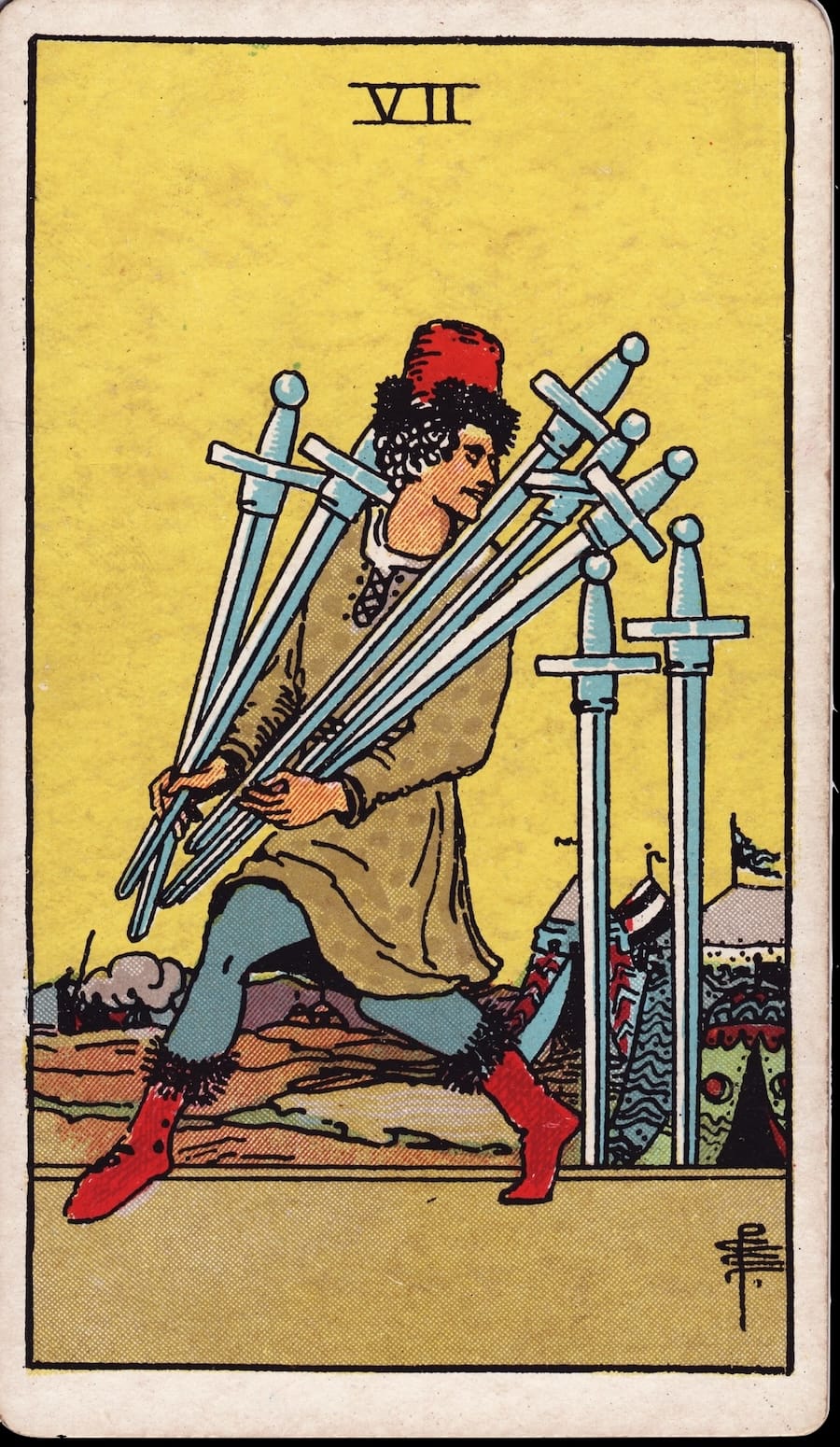
VII of Swords
I shared the card above. It’s an important one to me, generative and vexing. For a long while I revelled in what it has come to be known to represent: trickery, scheming, strategy, resourcefulness, sneakiness, and cunning. And also lies. I never revelled in lies, but I did once upon a time become a little too enamoured with my own cleverness and ability to shape narrative and perception—which is not the same as lying, but also not altogether honest, too.
But I loved the “metis” of the card: the wise and pragmatic cunning.
During my protracted dark forest chapter, though, I found myself contending with its reversed meanings: the end of playing games, the dropping of pretension, the consequences of actions, coming clean, and changing approach. I came to see my profession—that of “thought leader”—to be filled with charlatans. Not all, but many. And that I was no better.
And so I doubled-down on intellectual honesty, and living with greater integrity. I strove for honesty—even when it came at commercial and personal cost.
But for a while I flexed too hard into the reverse VII of Swords. My living in right-relations with honesty became a puritanical quest for purity. I mostly abandoned centralised social media and algorithmic surveillance platforms. I avoided doing the half-truth bullshit artistry that makes for effective proposals and sales pages. I spoke out against genocïde. I wrote (and continue to write) museletters that expose the inner workings of my heart and mind, allowing (the performance of?) authenticity to eclipse the performance of authority (much as I lust for curiosity to eclipse conviction).
In short: I went too far, and I have since been on a path to recover the wit and wiliness that make wisdom more effectively realised. I’ve since come to make a kind of restless-peace with my complicity amidst it all, whilst working to be situated amidst the trouble so as to better shape what may yet become.
I share this with you because Kim and I recently acquired a new tarot deck—LUX by Uusi. This lush deck of linocut artwork also comes with a companion book of sonnets. And in this companion book I found the most beautiful sonnet that reconciles and redeems the conflicted nature of the VII of Swords.
Oh what wondrous confluence and stirring! I’m not sure if it will have the same resonant impact with you, but I shall share it with you anyway.
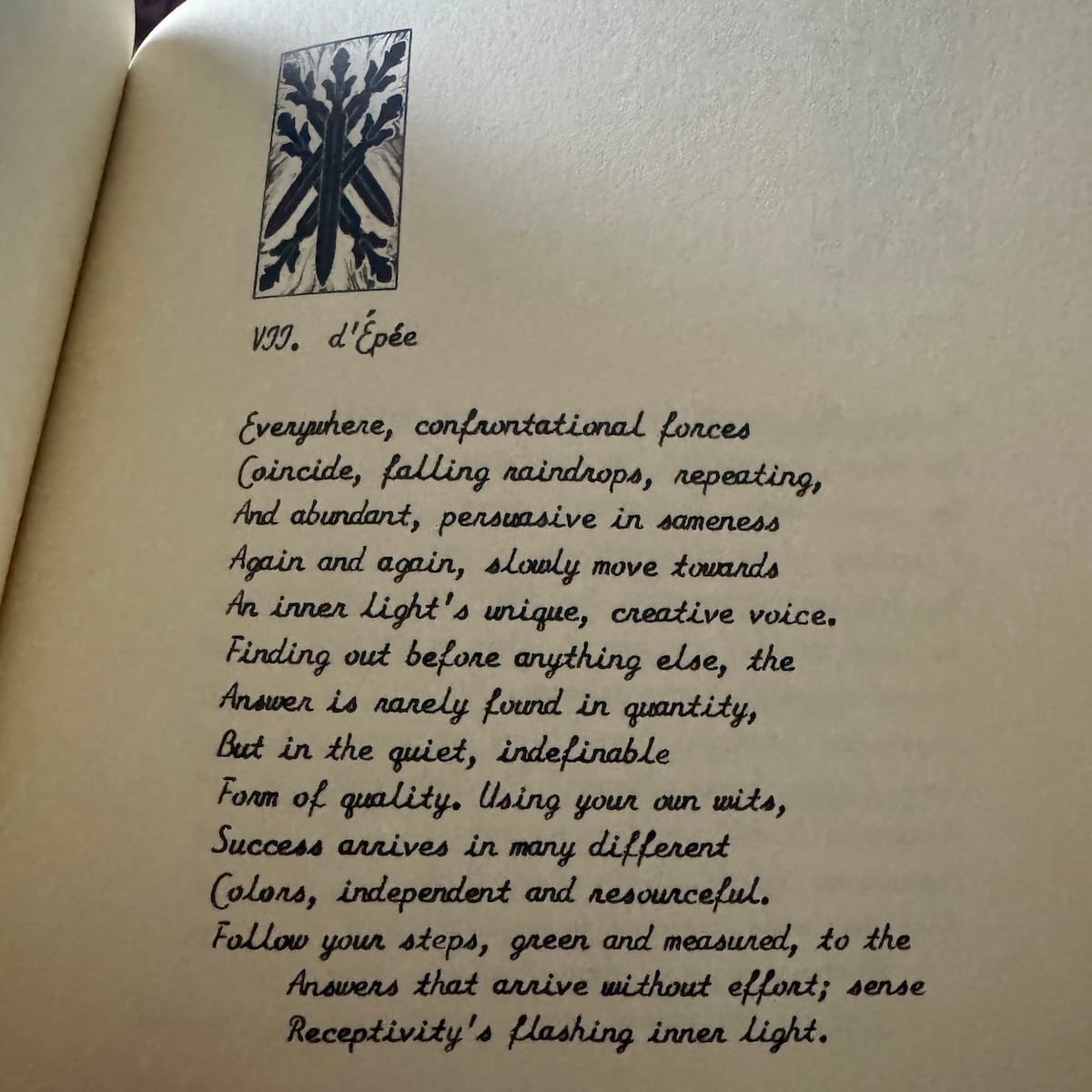
Receptivity’s flashing inner light.
Reflecting on reflections
I had a wonderful conversation with Tom Hirons the other day. Tom is a poet I love whose work has been such a warm beacon amidst the dark of my own questing. Tom and I both share a friendship and deep respect for Matthew Stillman, whom I shared a recorded podcast conversation with in last month’s museletter.
I made the mistake of listening to the episode I recorded whilst at the gym, and lamented my ineptitude as conversation partner and host. The verbose inelegance in which I ask questions. The effusive vagueness within which I interject myself. The rolling ums and “you knows” and “I don’t knows” and just—shut up, man! Ugh. I would have literal full body cringe at the sound of my own voice. It rubbed me the wrong way, summoning a harsh inner critic to whip at me for all my failings, now recorded in perpetuity and on display for the world to see and hear.
Tom shared that he never looks back on his recorded work. I don’t normally do so either—and I am freshly reminded as to why!—but Tom further added: it is not natural to see our own reflection. Other than the occasional polished stone or still lake water surface, we humans would spend much of our lives without the myriad mirrors and devices that amplify self-consciousness.
This is true for most of human history—99.8% of the ~300,000 years of anatomically modern humanity. And it is likewise true in the same sense that Josh Schrei asserts that animism is normative consciousness.
Anyway, this reminder has stayed with me.
Two weeks ago I recorded “Episode One” of “Season Two” of the foxwizard podcast. I recorded it with video, too, because apparently people watch podcasts on YouTube, and it’s the “most optimal” thing to do. Yet—I haven’t been able to share it. And I think it’s because there’s something about speaking to a camera whereupon I can see my reflection in realtime. It’s not natural to experience this.
This doesn’t happen when I’m in conversation with someone—like all of the wonderful Kindred Spirits episodes with my friend John Anthony. I can dissolve into the relationality.
Btw, a new episode of The Kindred Spirits Podcast is out—“Buffer Ye Orbs.” 🧡
 John Anthony and foxwizard
When I am flying solo, my favourite episodes from Season One of my podcast were the ones that were audio-only and recorded in nature; an extravagant equinox (recorded by the Birrarung river) and knowledge of curses (recorded by a pond on an island off an island off an island). There’s something about this mode that side-steps all self-consciousness.
Yet recently, two of my favourite podcasters passed away; Jim Rutt and Gordon White. Both were complex characters whose perspectives I didn’t always completely align with. But this is a redundant sentence because the same is true of everyone I know! Both had a generosity of spirit I remain inspired by.
Jim Rutt—the deeply curious and warmly cantankerous game-B advocate whose podcast served as a nexus and bridge betwixt the overlapping perspectives of those of us who quest for something beyond the default omni-lose game-A paradigm—passed away only two days ago. I had his latest episode with my friend Tyson Yunkaporta downloaded and ready to listen to. Jonathan Rowson wrote a lovely honouring to Jim Rutt. Jim’s was a unique voice that many a session of The Coterie (a private collective of questers and complexity practitioners) gathered around in the early days of the pandemic. He will be missed.
And Gordon White was someone I only recently became acquainted with, having first discovered him via his essay on What Escapes Capture. I had always intended to meet with Gordon when visiting Tasmania. Yet Gordon passed away suddenly (of natural causes) only a few weeks ago. He was around the same age as me. There have also been some lovely honourings of Gordon.
Deeply inspired by Ursula Le Guin, Gordon White was (and frankly still is) the only prominent Western magical practitioner that took the work of cultural Anthropology seriously, and the voices of indigenous people, and humbly learned from them. Up until that point, when the Western occult encountered non-Western practices, the tendency was to interpret through the lens of their framework which they implicitly (or explicitly, in more embarrassing cases) assumed was the Best. Even the most left-wing liberal practitioners essentially perpetuated the metaphysics and underlying world view of the most abhorrently racist wealthy Victorian colonials. It wasn’t just that he took their world-views and life-ways seriously, he literally travelled to these places, and physically met and spoke to practitioners from traditions that had not undergone the same destruction that our traditions were subjected to.
Gershom White also observes that Gordon would likewise choose to ‘stay with the trouble.’
Staying with the Trouble is the title of one of Donna Haraway’s books, and a term she uses to describe the act of realising the fact and tension of living in a troubled world, without a rush to find a “fix” or “solution” or a retreat into apocalyptic cynicism. Gordon White took this on board and applied it to his work. He considered and wrote about the disastrous after-shocks of Empire and its sinister continuation, and what that meant for Western Magic. Rather than ignoring it, or disavowing it (as many do, projecting it onto whatever they currently dislike often under the guise of a “fight” so they can avoid doing the work), he reflected on how to come into relation with these tensions and uncomfortable facts. Just by noticing “yes this happened, and yes, it was bad” can move towards healing and integration rather than a “solution”.
Peter Grey also wrote an honouring, concluding with a question worth living:
What is it that is ours to do now?
All of this is really to say: life is terminal! We’re only here for a brief little while, and it all may be over sooner than we suspect. I don’t mean this as something maudlin; it’s vivifying. Our lives are sacrificial, and I’m heartily reminded to get over myself so that I can be more present to whatever Life and wyrd and heart and whim call for. This museletter has been a way of wending to this realisation, and I am grateful for your company.
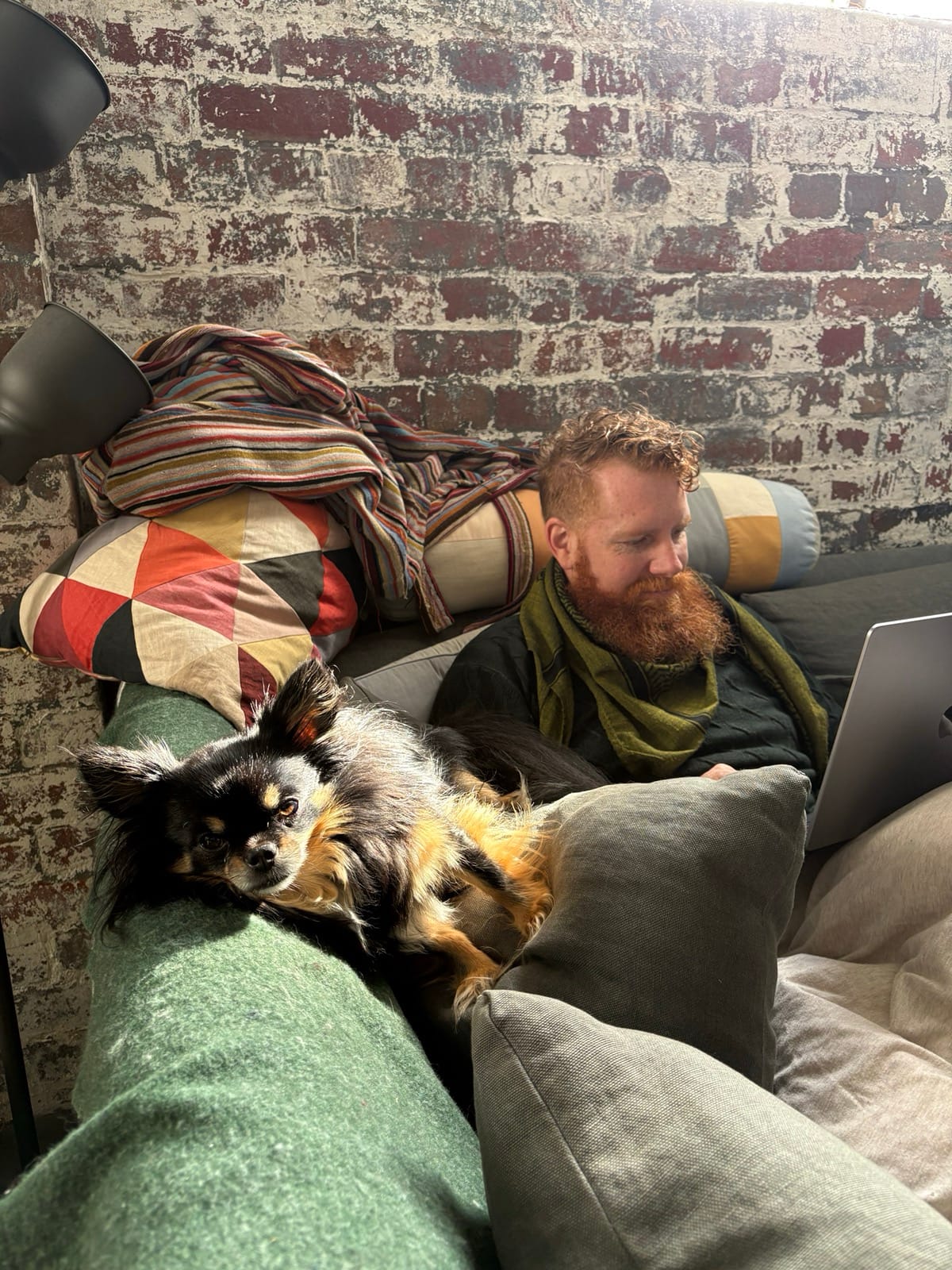
The next blue moon is on the 20th of May 2027. That’s just under a year. What might you wholeheartedly commit to, betwixt now and then? I know what I’ve quietly committed to. Let’s see what unfurls.
Much warmth to you,
Jason
Member discussion