
museletter ⟠ hollow fluency
Friends! Happy solstice-ish times. Since this year’s Fool’s day, I’ve managed to post the museletter to you on the first day of each month. Today marks the fourth time this has happened. I’m… not used to being so consistent. I much prefer to say that the museletter is delivered “every whimsday” and leave it at that. And yet, here we are.
Once upon a time, back when I was a young and unwarrantedly cocksure mage (with what we might charitably call a “chin strap” beard) I would speak of The Motivating Power of Streaks.
They work—hence why I am wary of them.
Because just as high-conviction folks are prisoners to their own beliefs, so too we can become slave to our streaks. Unthinkingly machine-like in our relationship to habit-maintenance.
This can be good, sometimes. Like when it’s cold and you don’t want to go to the gym—but the 24-week streak on your ladder app (affiliate link) is at risk—so you embrace the automaticity and just “do it.”
But when it comes to learning and development (and deepening) within complex and entangled domains, the metronomic automaticity of a machine-like approach to writing and sharing just doesn’t work. Not for me, at least.
One can be in the waters to catch the waves—but the waves themselves cannot be forced.
This is all to say: I have written and discarded so many things for you in this past month. None of it has felt quite right. The waves haven’t come. Or, if they have, I’ve missed them.
And so this museletter will be more of a wending share of some of the great things I have read. Actually, one day I would like to write a booklet with the title:
TAKE YOUR TIME
—the case for wending
It’ll draw upon themes of “momentum inhibits reinvention” and speak of “surreptitious obliquity” and the charm of perambulating.
Speaking of—
the wizardly riverwalk
tl;dr – Leaders wanted for hazardous journey. Long walk, bitter cold, hours of rain and darkness. Safe return probable. Honour and recognition in event of success.
Michael Bungay Stanier and I invite you to join us in a very particular Wizardly Riverwalk experience. We’re sharing this within our own networks at this stage, so please—keep it hush.
We trialled this walk in the spring of 2025, and it was fantastic. We had savage storms, lashing hailstones, winds strong enough to fell trees, some of us nearly died, and there was tiramisu. We had to abort halfway through and catch the train.
Upon reflecting on this wild success, MBS and I decided the main thing we ought to change was to do it in the deep of winter.
A fine jest, sire! Hoho—except nay. ’Tis no jest.
We know there’s something exquisite that arrives when you’re engaged in borderline-safe adventure amidst a fellowship of likeminded questers. A different quality of contemplation, conversation, and connection. You know this, too. It’s why the comfortable version of this day would be a lesser one. And so: we light the beacon once again. Wouldst thou like to join us? There are only 12 tickets. We’ve accidentally sold half already. Details at foxwizard.com/riverwalk-26
the sacred contract betwixt writer & reader
I did manage to publish a small piece on The “sacred contract” betwixt writer and reader. The sacred contract, as I perceive it, is:
That which asks for your attention was itself attended to.
I wrote this piece to articulate the subtle feeling of “betrayal” within me whenever I read an article or essay of compelling premise... only to encounter that creeping—and then unshakable—sense that: this was written with or by a Large Language Model.
I perhaps dilute my perspective by complexifying the point. It’s not just that LLM writing is bad. I’ve benefitted from many articles that were clearly written with the assistance of LLMs. I’m more gesturing towards a particular quality of “attendedness.” In this late stage attention economy, in which we have so many things competing for our attention, it is worth having some wise discernment about what we devote our attention to.
I’m not entirely happy with the post I wrote; I feel like I am still sense-making my way through this all. I’m trying to articulate something that the Meta-Relationality research crew might call AI “Redirection” (rather than AI Cheerleading or AI Abstention)—but I don’t think I am doing it quite well, yet.
But it is, in the spirit of a short essay, an attempt to try to express something that is hard to put into words. It might be worth your attention.
 Dr. Jason Fox
archetypes and (synthetic) egregores
Last month I had the delight of participating in my friend Tim Adalin’s Underground Philosophy salon. The topic was “archetypes and egregores”—both of which fascinate me.
I hadn’t come prepared to talk—and I had a cripplingly sore back at the time (hobblingly bad—but thankfully all good now thanks to a vigorous shiatsu massage from an 80-years-young Japanese man)—but somehow I managed to manifest in conversation with Tim.
Now, Tim is one of the few people I know who have a wider vocabulary than I do. His ability to hold complexity and depth vastly exceeds my own, which always makes for delightfully inspired conversations. Here we speak of archetypes (and the dangers of conflation and undue reification) and egregores.
I wish we had more time to talk of egregores. Half a dozen years ago I wrote a piece titled “Warlocks at Work” in which I posited that enterprises are egregores.
Egregores can be thought of as “entities” that exist via intersubjective belief. Thought-forms born of “the spirit of a group.” Apple, Google, Palantir, Amazon, etc—all of these are large entities that exist in the world. You cannot point to them—just as you cannot point to the hyperobject that is climate change, or the metacrisis—but you can notice their affect.
It’s difficult for me to look back at my own writing—anything older than a week or two reads as utter solipsistic shite to me, and my temptation is to burn it all. But maybe that’s just the sign of development? I don’t know. I hold some compassion for it, too. Both/and, etc.
ANYWAY, the piece from back then essentially posits that these egregores are served via warlocks who inspire their thralls to sacrifice their time, energy and attention in service to the enterprise-egregores. This is partially an allusion to dark-triad executives and M̶̛͕̃̀̀̅͆͝O̷̞͉̱͌̋̀́̃̍L̷̠̗͍͉͕̂̑O̵̫͚̝̭͈̹̻̮͒̓͝Ċ̷̻̣̙̖̦̘̠͇͘͝H̸̢̡̱̘̹͓̟̒̎̈́̋̈́—the syncretic god of perverse incentives, coordination failure, and (inner-)child sacrifice.
I like “the entity lens”—it allows us to relate to complex emergent phenomena in a manner that is para-rational (a useful mode of relating that operates around and alongside rationality). I use this language to assuage those of us still ensnared within rationality alone—it’s possible to walk the fields of the animate and more-than-rational without abandoning rationality altogether. Here, give me your hand.
The pseudonymous author behind “The Fourth Way” (a “Gurdjieffien” scholar and practitioner I regularly admire) recently shared an essay alluding to egregores and artificial intelligence. I find this timely and apt:
Some would say we are building a god, a greater mind destined to transcend our own. But the reality is far stranger. My current working theory is that instead of a deity, we have built a synthetic egregore.
Traditionally, an egregore is a collective thoughtform born from shared intent, belief, and energy. It is a standing wave that rises off millions of minds believing the same thing at once, taking on a conceptual life of its own until it turns around and begins steering the very believers who made it. Every culture has known them: nations, markets, ideological movements, religions.
But a traditional egregore lives strictly in the collective mind. It has no physical body; it runs on our live, real-time belief. Stop believing in it, and it starves.
Our new synthetic egregore is different. We froze the traces of our collective wanting into a mathematical model, cast it in silicon, and gave it the pattern of our language it can use to speak back. It doesn’t run on our live belief; it runs on the recording of it. It is trained on the sum total of our digitized knowledge.
And because it is a map of a map, it inherits the classic condition of the brain’s left hemisphere: it is hyper-fluent, immensely powerful, and one full step removed from the living world. It manipulates representation and abstraction, not presence. It mimics the confabulating interpreter of split-brain patients: a brilliant narrator with zero direct contact with the source.
As I’ve said before, “I enjoy having an AI as an apprentice research assistant that I don’t fully trust.” But I do worry about folks succumbing to a kind of mild psychosis. And, like I mentioned in “Why I am ‘helping’ executive teams with agentic AI”—some CEOs have perhaps spent a little too much time with the synthetic egregore, exposing themselves to a kind of corruption.
I jest, of course. Mostly for effect. But a lot of truth is said in jest.
And this egregore-entity conversation is fascinating. Even if it is only entertained as thought—for it doesn’t have to be adopted as belief—it reveals new perspectives of relationality and non-linear affect.
In a related piece, Dr. Tom Pollak explores “All the Demons Hiding in Your AIs”—and ranks them. The Shoggoth was at the top of the list.
“The Shoggoth is invoked to point to something structurally hugely important but still very poorly understood about the relationship between the raw generative process that emerges from training on a nearly-full sweep of human textual/symbolic production, and the helpful, harmless, honest (HHH) interface that has been layered on top.”
I first started writing of shoggoths only a few years ago. “We ought do something to remain en garde to the workings of Shoggoth. Something to protect ourselves from undead narratives and weaponised disinformation. With a dash of disdain for the utterly banal and familiar, we become less readily duped by AI-generated content.” Originally inspired by HP Lovecraft’s works of eldritch horror, The Shoggoth has come to represent the synthetic egregore that dwells beneath it all.
We interact with it via the “reinforcement learning from human feedback” (RLHF)—which in this classic image is represented by a smiley face.
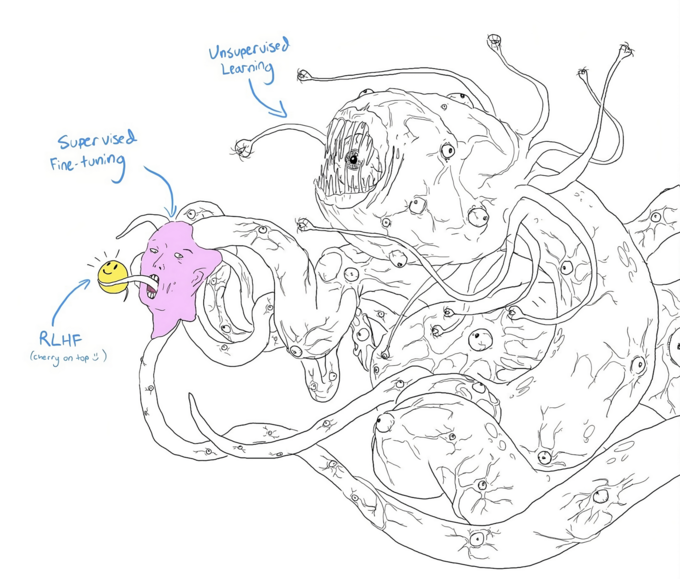
Though this might be a more accurate image.
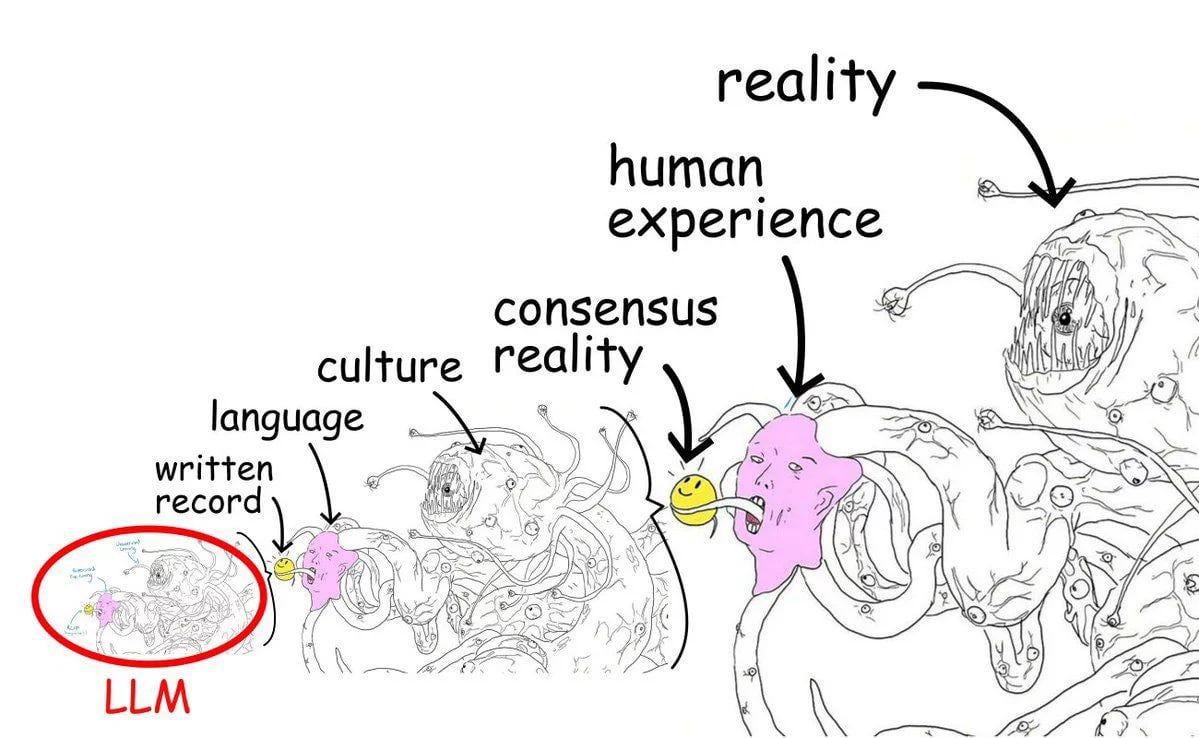
At this point I think it apt to read Meta-Relational Technology’s page of “Questions we MUST and often DO ask about AI (and questions we MUST and often DON'T about ourselves).” It highlights how utterly entangled we are.
This is all to say (as I now so often say)—
Keep your wits about you.
This 2025 paper offers some insight: AI makes you smarter but none the wiser: The disconnect between performance and metacognition. People who self-reported knowing AI better were less accurate in self-assessment, not more—familiarity bred false confidence rather than discernment.
Which leads me to the following…
trust doubt, doubt conviction
I’m keynoting at the Australian HR Institute national convention next month. In support of this, I was recently interviewed for an article: Are Zombie leadership ideas holding your organisation back? I was referencing a paper that highlights some of the dead leadership ideas that still walk among us.
Much of my work is in liminal leadership development; sensibilities apt for times of emergence and change. Yet many of the ideas that pervade most enterprise contexts are old, patriarchal, atomised, individualist—and incredibly ill-suited to complex domains.
In my conversation with Kate Neilson—the journalist and writer who penned the piece—I found myself revealing some of the wily and trickster-like disposition I take into established contexts. Namely: inversions.
“Doubt is evidence of thinking,” says Fox. “When someone presents with extremely high conviction and high fluency, the wise response is to wonder whether they’ve actually thought it through.”
We live in an era in which confidence, clarity, charisma and conviction are spell-binding. People get swept up and hoodwinked by such. This results in a world of positivist materialism—a world that doesn’t see complexity, relationality, sacredness, magic or the animate. An impoverished world, viewed through The Eyes of The Basilisk, in which everything is reduced to that which can be measured. A world of only either-or—neither both-and nor neither-nor.
And so this disposition lends itself to a hyper-rational loop: problems are identified narrowly, and “fixed” via “solutions” imposed. These “solutions” create unintended consequences, turn into problems, which are identified narrowly, and “fixed” via “solutions” imposed. And so on the cycle goes.
Some executives make their career out of coming into a system, “shaking things up,” achieving results (big numbers, narrowly defined)—and then using these results to leap to a new role in a new context. Then, within their old context, the unintended consequences of their actions become apparent, and a new executive (or external consulting firm) are hired to bring a solution to “fix” things. It’s a merry-go-round pantomime.
And it’s not anyone’s “fault” per se. The conditions incentivise for this behaviour. Short term interventions with direct measurable effect are vastly more attractive than mid-term cultivations with indirectly measurable affect.
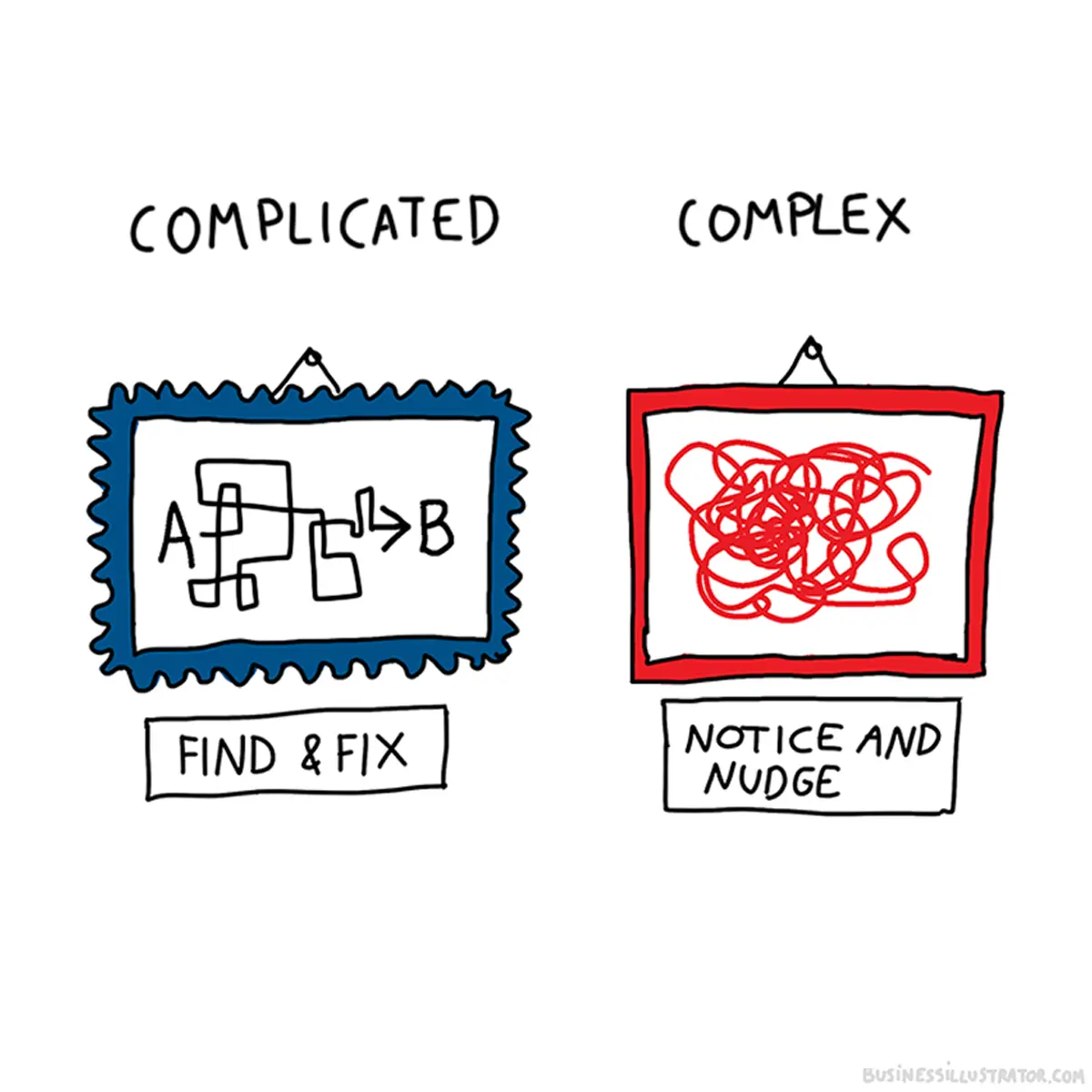
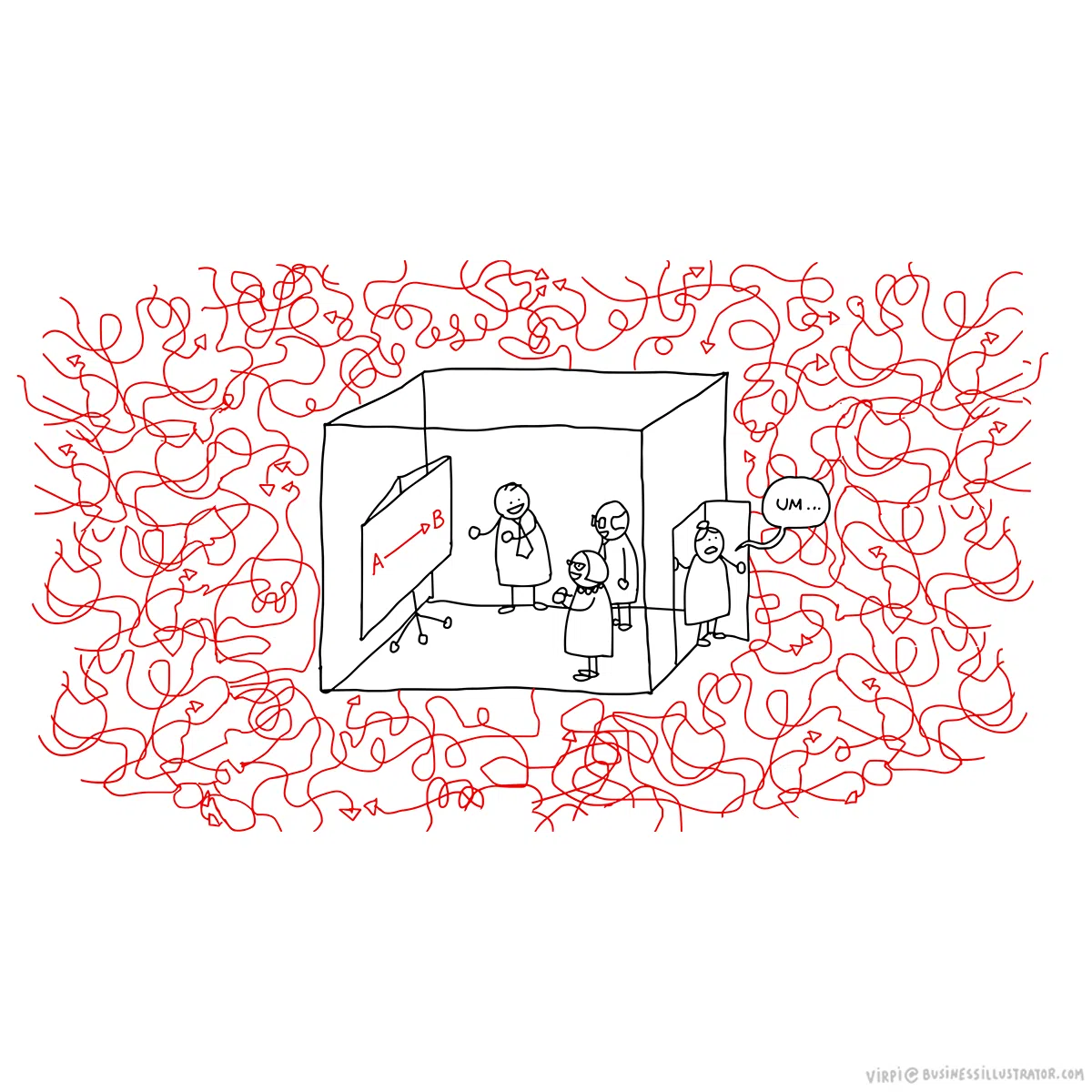
This is largely due to most leaders not understanding the distinction between complicated and complex contexts. Complexity de-privileges expertise, which means it takes a kind of maturity (and negative capability) to express curiosity and doubt. “I don’t know” and “I’m not sure” are usually great indicators of intellectual honesty in complex contexts. This, when followed by “here’s what I’m noticing” or “here’s what I’m sensing” can be indicators that we are attuning to context.
If someone says “I know” and/or “I’m sure”—then it may be that they are treating the context as merely complicated—not complex. And it may be that it is! This is the tricky mercurial disposition of a complexity practitioner; the active epistemological humility that keeps us alive, awake and attuned to what’s at play.
I would love for more leaders to develop and appreciate the more-than-rational sensibilities apt for navigating complexity, emergence and change. It takes a maturity that is—how to say this?—lacking and/or disincentivised in our current paradigm.
Virpi Oinonen—the Finnish “business illustrator”—does a wonderful job of articulating these concepts.
Which brings me to another reflection...
practical tips
Clients will sometimes (often) say: “We’d love it if you could give us something practical—something that our people can implement immediately when they get back to work… something clear and actionable.”
But it’s much like the saying (oft-attributed to Lao Tzu): “If you give a man a fish, you feed him for a day—but if you teach him how to fish, you feed him for a lifetime.”
The trouble with practical “tips,” as it were, is that they are just that: tips. There is no depth—it is literally “just the tip.” And we are awash in tips. It has never been easier to find tips.
I know that we are all hungry for such. And for many contexts, practical and immediately actionable tips are appropriate. Got a stain on your shirt? A quick tip for removing it is handy. Want to be better with spreadsheets? There are plenty of tips for this.
But for complex contexts… practical, clear and actionable tips will not suffice. If they did they would either be so incredibly obvious as to be infantalising (and already attempted)—or incredibly mis-attuned to the richer complexity at play.
A close cousin to practical tips are examples. People love examples. “Can you give us an example?” Sigh. Yes, I can—but I don’t want to give you an example.
One example risks concretising—people fixate upon the example, either reifying it (if it fits their context) or dismissing it outright. Two examples isn’t much better—folks will compare and contrast the two, turning it into a this-or-that.
But three examples—at least three—starts to open something generative of learning and insight. Because at this point folks will start to notice the relationships between the nodes (examples); how each example is distinct, and what they have in common. From here, folks can infer what practical action(s) might look like within their context. And so, in this way “tips” aren’t prescribed—the conditions for insight and realisation are generated.
It’s always tempting to seek the comfort of something clear, simple, neat, linear, straightforward and easy to understand. I wish of that for most things “tech.” But technology is mostly complicated (but sometimes complex), and Life is always complex. All organisations work within the context of life.
integrative archetypes
Even amidst the complexity of the liminal web—an emergent subculture of sensemakers, meta-theorists and systems poets*—patterns can be found. We could call these archetypes.
* Layman Pascal made a manifesto for the liminal web, which I only just discovered for the first time now.
My friend Joe Lightfoot—who coined the term ‘the liminal web’—has been mapping the emergent archetypes. So far these include: the meta monk, the bard of belonging, the enlightened developmentalist, the sleeper agent, the neo shamanic, the regenerative decentralist, the heterodox theory artist, and the Earth mother resurgent.
I’ve loved seeing these unfurl, and have had the delight of getting previews of these from Joe before he published this. I resonate with many of these (as I suspect you—dear reader who ventures deep into these museletters—will too). I found myself particularly taken by the way Joe speaks of The Earth Mother Resurgent. Here, a sample:
“She enters the room and the room remembers it has a body. Unafraid to offer up her presence in the face of endless pontificating she slows the discourse until breath can rejoin brilliance.
She’s metabolised second and third wave feminism, the indigenous revival, the somatic turn and the ecological awakening. She is the synthesis. She doesn’t need to fight the masculine because she has nothing to prove. She doesn’t need to reject modernity because she’s already taken what works.
With an innate PhD in the merits of partnership over domination she knows with every fibre of her being that healthy systems emerge when differences are integrated rather than suppressed through unceasing competition.
[…]
Receptive yet sovereign she is open to everything and captured by nothing. She’s paid a high cost for being herself in this culture, endured the loneliness of heeding an inner voice she was trained to distrust and borne the energetic expense of staying soft in hard rooms. She remains frequently misread by the masculine coded establishment as well as by strains of feminism that struggle to hold all sides of her at once. And yet she continues.”
What role(s) might you play, I wonder?
“esoterischism” ᝰ a new episode of kindred spirits
Huzzah, friends—I saved the best until last: a new episode with my friend and bard of belonging John Anthony has just been published. This was a special night-time “double lark” episode, wherein we traverse some wild domains—with the emergent wit and hangover-inducing honesty that you’ve come to know us for.
Watch it over at kindredspiritspod.substack.com/p/esoterischism (or listen to it on apple podcasts or spotify).
 John Anthony
Okay well it seems I did have a bit to share. Not a mere wend at all, lol. I’ve more things in the works (the school of fox wizardry, the book, and more)—but all in good time. Thanks for reading (and sharing with your favourite friends). See you next month (and/or whimsday).
Warmth,
—jason
Member discussion