
A Hermetic Disposition
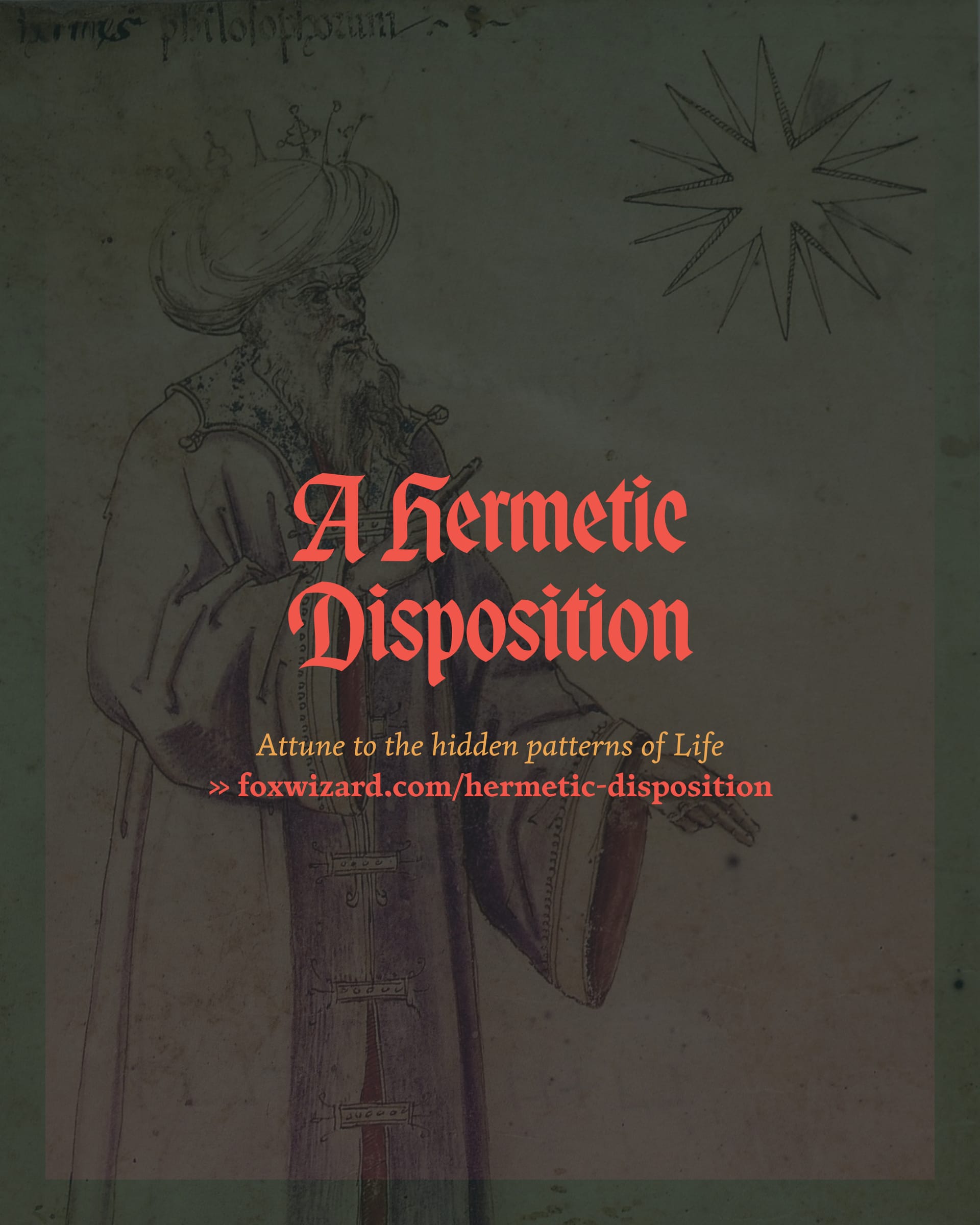
Last week, when in the initial exuberance of being a guest on my friend Kelly Butler’s new podcast—A Language of Suffering[^ Launching in 2026.]—I waxed loquaciously about ‘the hermetic disposition’, with much gesticulation and flutter. My friend (and the podcast’s co-host) Matthew Stillman asked me to elucidate for listeners who might not be familiar with the term. And in hindsight, I think my response would still baffle most.
And so, here I manifest on my quiet blog to succinctly articulate wtf hermeticism.
So: hermeticism
Amusingly, one of the dictionary definitions of ‘hermetic’ is:
Difficult to understand because intended for a small number of people with specialised knowledge.
I guess such is the way when we slip into cant.
“Hermetic” refers to the tradition of thought and practice attributed to Hermes Trismegistus—a syncretic figure formed from Hermes and Thoth. The core corpus is the Hermetica, a collection of texts dealing with divine knowledge, cosmology, and the relationship between the divine and material realms.
But have I read these all? And is this what I mean by ‘hermetic disposition’?
The answer is: kinda?
There’s a way in which occult texts tend to be written that behooves a wit that must be maintained in how they are read. Because vital wisdoms and living concepts can lose their animacy when written down. They become fixed and then reified in this fixed form. And then memetic drift occurs and we stray. Oh how we stray.
“Atheists are just modern versions of religious fundamentalists: both take religion too literally.” — Nassim Taleb
This is why poetic and aphoristic styles are often so evergreen and so enduringly potent. The vitality of their meaningness has not been dullened by explanation. Just as the tao that can be described is not the eternal Tao, and the name that can be spoken is not the eternal Name, so too with hermetic sensibilities.
And so now, with that caveat-waiver, allow me to describe the hermetic disposition to you.
A disposition
... that we might call ‘hermetic’ is one that orients toward a view of reality as inherently interconnected and alive. An unfurling eternal that manifests through correspondence, resonance and interrelatedness. It’s a disposition that calls for us to dance with and within a cosmos that is animate and ensouled.
The hermetic disposition is notably different from materialism and pure mysticism. A hermetic practitioner neither reduces reality to mechanical categories, nor dissolves into undifferentiated experience, but senses into the hidden patterns of phenomena, and works with them.
In this sense, the hermetic disposition shares the same delight for contradiction, ambiguity and paradox as how David Chapman describes the mythic mode.
“The mythic mode not only tolerates, but actively enjoys, contradiction as well as ambiguity. [...]
Reasonableness is not comfortable with contradictions, and will try to change the subject, or obfuscate when they can’t be avoided. Rationalism, of course, rejects contradictions outright. It is founded on the Law of the Excluded Middle. [...] Rationalism insists that every possible proposition is either absolutely true or absolutely false—in the face of constant evidence that nearly all of them are neither.”
In contemporary context, the hermetic disposition is one that embraces a knowing that: surfaces conceal depths; conventional explanatory frameworks are always incomplete;[^ Bonini’s paradox explains this, too.] and attention to pattern, synchronicity, and symbolic resonance hints to the nature of how things actually work.
Much of this all forms a particular soup that folks like myself, and perhaps you, have come to appreciate. In slightly more practical terms, the hermetic disposition can be expressed via seven principles.
The seven hermetic principles
... can be gleaned from the modern occultist publication known as The Kyballion. And even though the book itself is syncretic (like Hermes Trismegistus himself), and even if the title was made up (potentially to convey ‘a false sense of antiquity’)—I like it.
The principles of this kind of hermeticism overlap and ‘play nice’ with other dispositions such as meta-rationality, mythic-mode, The Fourth Way, witchcraft, trickster, infinite game, gestalt, druidic, and more.
The seven principles are:
I ⟠ The principle of mentalism
The All is Mind; the Universe is Mental.
‘The All’ [^ All that is apparent to our material senses is unknowable and undefinable, but which may be considered and thought of as “a universal infinite living mind.”] is the substance of existence; the material is mental manifestation. Consciousness isn’t epiphenomenal; it’s constitutive.
This talk of ‘mentalism’ could be mistaken as a cerebral gesture. But that’s too limiting. Relate instead as something akin to mind/energy/matter/spirit and consciousness being of and from <flaps hand> The All.
In practice, reality responds to thought and intention more than mechanical causation might otherwise suggest.[^ But note: this doesn’t mean reality obeys thought and intention. Related to this is the notion that we each have a ‘daimon’—a term that itself has many ways of relating to. I particularly appreciate Dutch philosopher Bernardo Kastrup’s treatment in The Daimon and the Soul of the West:
“The Daimon is just nature as it expresses itself in us and through us. And nature is, of course, impersonal. Its agenda is universal and holistic, not restricted to the petty egoic tastes and preferences of a person. It is naïve to expect a human being to be able to comprehend the Daimon’s universal agenda, just as it is naïve to expect an apple blossom to comprehend what its role is in the grand scheme of apple trees and life on Earth. We are segments of nature, not mere witnesses; we didn’t parachute into nature, but grew out of it. Therefore, we are nature, as expressed in a particular volume of spacetime. Given this, it is also naïve to expect there to be no impersonal force—no impersonal will—acting within us, and through us; of course there is. And I call it the Daimon.”] This undercuts the sandstone castle of materialist ontology, and hyper-rational ways of seeing (with strict categorisations between this and that).
This principle instead gestures toward something more like panpsychism or pantheistic idealism—without committing to either explicitly. Ergo, the principle preserves conceptual flexibility (which is both meta-rational and trickster).
II ⟠ The principle of correspondence
As above, so below; as below, so above.
Or, more accurately—
Quod est superius est sicut quod inferius, et quod inferius est sicut quod est superius. That which is above is like to that which is below, and that which is below is like to that which is above.
The universe operates through proportional analogy across all scales. The patterns governing atoms govern solar systems, human psychology recapitulates cosmic principles, and remedies for bodily ailments correspond to celestial configurations.
Naturally, there can be a slippery slope with this kind of thinking, and I hasten to add that we do not abandon rationalism in the embrace of hermetic principles.[^ I’d also note that the principle of correspondence is more emergentism than determinism. Or, ‘evolving perennialism’ as David J. Temple might say. Or nebulous-yet-patterned, as David Chapman might say.]
But understanding the principle of correspondence means that you will likely sense how holonic patterns and conceptual ‘simplicities’ hold true across contexts and orders of complexity.[^ This principle also points to how symbolic magic and astrological ritual can enact celestial patterns at human scale—I’m new to this way of seeing, though, and can accept that this may seem ‘too woo’ for most.] These can become ‘beacons’ that you might orient by (even amidst new and unfamiliar contexts).
III ⟠ The principle of vibration
Nothing rests; everything moves; everything vibrates.
All phenomena are vibrational frequencies at different rates. Consciousness itself vibrates at characteristic frequencies; different states of awareness correspond to different oscillatory rates. When you walk into a room, you encounter a field of frequencies—atmospheric, emotional, relational—that operate below explicit awareness. This manifests as “vibe” and it’s something that can be ‘felt’.[^ And the capacity to sense-into such fields can be cultivated, too.]
Practices like meditation, mantra, music, and ritual modulate frequency directly, shifting your vibrational state and altering what you can perceive and influence. Likewise, the way in which you show up, the quality of your presence, and the myriad subtle ways you intentionally ‘attend to frequency and vibe’ affects collective fields, too.
I see this all the time at events. Many of us are too swept up in our own egoic insecurities and are thus oblivious to frequency and field. But masterful storytellers, musicians and performers can bring the kinds of experiences where—even in a room of thousands—you could hear a penny drop. Where whole audiences breathe as one, sharing in the same harmonic frequency and field.
Much of the subtle deftwerk good facilitators do with groups is in the gentle cultivation of collective frequency. This cannot be rushed or forced, but it is worth attending to for the collegiality and warmth such brings.
IV ⟠ The principle of polarity
Everything is Dual; everything has poles; everything has its pair of opposites.
Apparent opposites aren’t separate forces but extremes of a unified spectra.
The universe requires polarity to manifest; unity alone cannot generate differentiation. There are no mountains without valleys. No self without other.
This is particularly well expressed by James P. Carse writes in Finite and Infinite Games.
“One cannot be human by oneself. There is no selfhood where there is no community. We do not relate to others as the persons we are; we are who we are in relating to others. Simultaneously the others with whom we are in relation are themselves in relation. We cannot relate to anyone who is not also relating to us. Our social existence has, therefore, an inescapably fluid character... this ceaseless change does not mean discontinuity; rather change is itself the very basis of our continuity as persons.”
The whole premise of finite and infinite games is very congruent with hermeticism. Particularly with regards to the principle of polarity.
“There are at least two kinds of games. One could be called finite, the other infinite. A finite game is played for the purpose of winning, an infinite game for the purpose of continuing the play.”
Playing to ‘win’ creates losers. Over and over again. To transmute this dynamic requires that we find a third perspective from which both positions participate in something larger.
In trickster speak, this is the side-step; the tilt; the slip—an intentional shifting of the frame of reference and ways of seeing. Like how there are two sides to every coin. But nay—there’s a third edge to every coin. This is how we make them spin—with both polarities in superposition.
In mythic speak, this could be seen as perceiving the blue feather. “We are seemingly in magpie times—black or white, right or left,” Martin Shaw says. “But magpies have these blue feathers if you pay close attention. Myths speak blue feather language—they can be co-opted for sure, but they are meant to offer some third, artful perspective when culture is butting heads.”
V ⟠ The principle of rhythm
Everything flows, out and in; everything has its tides; all things rise and fall.
All phenomena oscillates cyclically—expansion and contraction, action and reaction, ascent and descent, life and death, inhalation and exhalation. No singular state persists; all is always in motion through rhythmic patterns. History, seasons, empires—all follow the principle of rhythm.
You’ve probably heard me talk of how momentum inhibits reinvention—both in a business sense and in a personal sense. There’s only so much we can do to thwart, deny or delay the seasonal turn that beckons. And any attempts to do so usually manifest in a more pronounced seasonal turning.
Understanding the principle of rhythm means riding waves, rather than resisting them. We surf with cyclical motion. Crises, suffering, struggle, pain and loss are therefore known as inevitabilities. Downswings naturally precede upswings.
In today’s world of relentless momentum and hustle, of non-stop distraction and extraction, our task is to often find and tend to the seasonality of things. Throughout the majority of human history, we have done this through ritual and myth.
“Only that which can change can continue,” James P. Carse writes. “This is the principle by which infinite players live.” So too the hermetic practitioner.
VI ⟠ The principle of cause and effect
Every Cause has its Effect; every Effect has its Cause; everything happens according to Law.
This principle reads heavy, but it relates to the first law of thermodynamics: energy cannot be created or destroyed, only transferred or changed in form.
Nothing occurs by chance; everything emerges from interactions. What appears as ‘random’ is merely the result of causation operating at a level of complexity beyond our perception and ken.
Now, this doesn’t mean you need to adopt a fatalist disposition. You can amor fati—love thy fate—whilst also attending to your wyrd.
Wyrd intertwines agency (‘free-ish’ will) with fate (the principle of cause and effect) generatively. You are not the determinator the forces that shape your fate, but the Fates themselves also haven’t completed your tale, yet. There’s a chance you can influence circumstances by, in particular, through how you relate to your circumstances.
Understanding cause-and-effect permits causation. You become a cause, rather than merely experiencing effects. Or so it might seem.
Attempting to evade the Law (of cause and effect) is futile. You can can only work from where you are, with what you’ve got. You can love the Fates, or rue them. But it’s probably best to both love them and keep your wits about you as to when and where you can play a part in shaping your own pattern.
VII ⟠ The principle of gender
Gender is in everything; everything has its Masculine and Feminine Principles; Gender manifests on all planes.
Gender here refers not to biological sex but to the generative polarity present in all phenomena. Masculine qualities are generally active, outgoing, assertive, focused, directional. Feminine qualities are generally receptive, containing, responsive, open, and formless. Creation and Life require both, and we have both within all of us. This is the anima and animus.
Wholeness requires integrating both the masculine and feminine within ourselves.
Over-identification with the masculine principle produces cold rigidity, narrow focus, and a disconnection from receptivity and the wider context. Over-identification with the feminine produces warm diffuseness without direction or focus, and receptivity without agency.
Different situations call for different emphases. Rapid decisive action calls for the masculine, whilst adaptation and responsiveness calls for the feminine. By adopting a hermetic disposition, you can recognises which context calls for which, and can shift fluidly between them—neither rigidly masculine nor passively feminine, but generatively both. Oscillating betwixt.
Suffice to say, the majority of my work in Enterprise Land—but certainly not all—calls for me to bring more feminine sensibilities; warmening relationality, expanding the field of consideration, attending to emergence, and so forth. This is because much of Enterprise Land runs on a patriarchal logic that is blind to it’s limitations. But this isn’t pre-determined, and it isn’t constant. Sometimes we need to soften into curiosity; and sometimes we need to harden into conviction. The hermetic disposition would have us sense-into what each context calls for, situationally.
And so thus
... Hermes “the Thrice Great” did apparently allude. To the trained eye, these principles are not so dissimilar to taoism and other esoteric forms. And again, the point here is to not become attached to the particulars. A hermetic disposition is a stance (not a mindset). A comprehensive suite of sensibilities, rather than a list of specific skills. A skill is one thing. Knowing when and how to use a skill (and, just as importantly: when not to) is a sensibility.
I am... not entirely sure that my small treatise here has done much to make things clearer. In the podcast we were responding to Byung-Chul Han’s The Palliative Society. It’s a polemic book that makes the case that we (as a society) fear pain, and that our ability to tolerate pain is diminishing. This is the same with all suffering, sadness, and sorrow. Our fear of these things leads to their suppression, bolstered via an over-indexing in comfort, happiness, and acceptability.
This has the effect of keeping us locked in what Byung-Chul Han calls the hell of sameness.
“The pain-free life of permanent happiness is not a human life. Life which tracks down and drives out its own negativity cancels itself out. Death and pain belong together. In pain, death is anticipated. If you seek to remove all pain, you will have also to abolish death. But life without death and pain is not human life; it is undead life. In order to survive, humans are abolishing them-selves. They may succeed in becoming immortal, but only at the expense of life itself.”
A hermetic disposition is a disposition that attuned with, and in service of, Life itself.
Member discussion