
🍂 How to Have a Nemesis

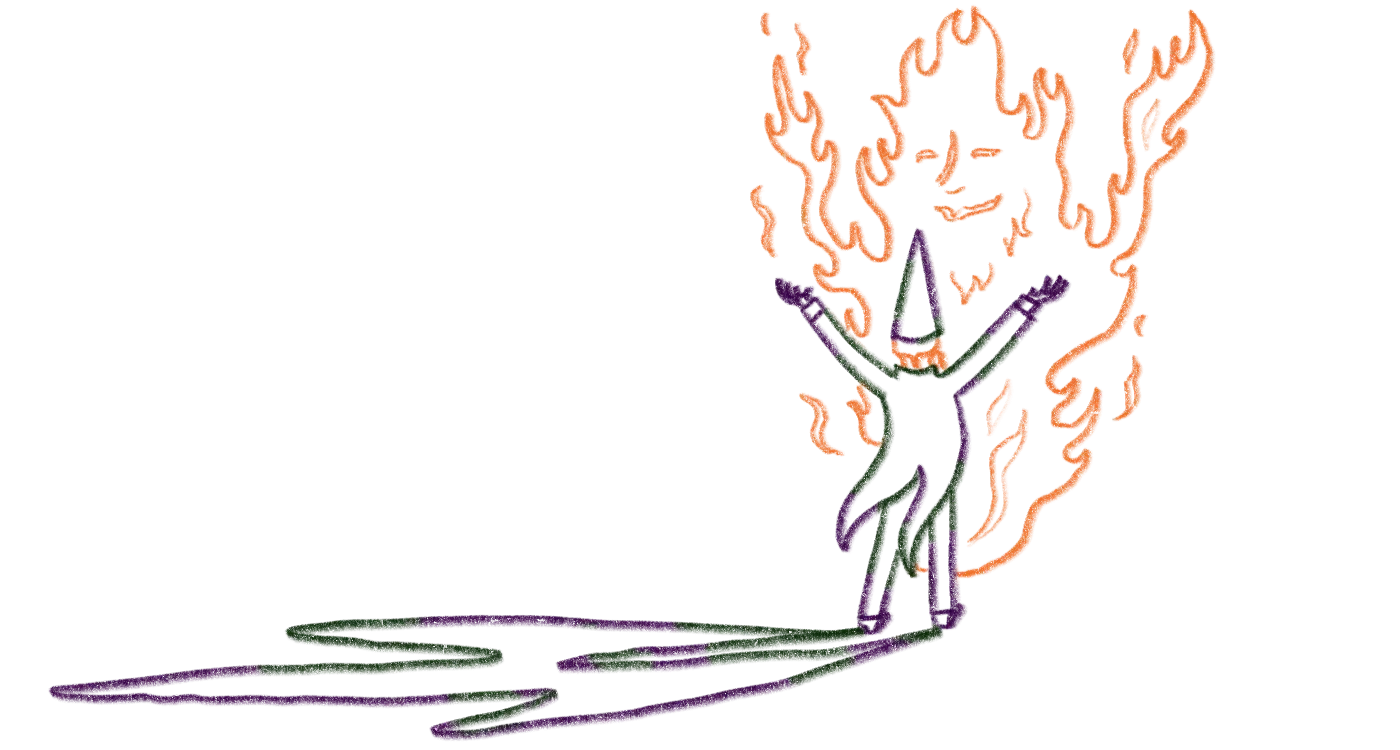
Illustration by dangerlam
// SCENE: the two of us, wingback chesterfields, overlooking the night sky, windowpanes wet with rain, flashes of lightning, a cackling fireplace, snifters of armagnac, long-stemmed wooden wizard pipes, a pair of cats to pat (one each), cupcakes, an empty suit of armour (no apparent reason), a set of masks upon the wall (peculiar)... //
So! Last month I caught up with some mates—comrades who swim in the same sea of wonder, possibility and bullshit as I do.* We were all in a clean hot spa-bath, chatting beneath the night sky whilst overlooking the ocean from the airbnb we had rented, waxing philosophical about the paradoxes of positioning.°
* I am speaking, of course, of ‘thought leadership’/professional speaking/coaching/consulting and the wider industry we contribute to (and benefit from).
° Being that the work that gets you work that takes you away from the work that got you the work in the first place.
At some point I asked a question of the group, to which I thought was quite clever:
Do you have a nemesis?
An ‘individual’ (or set of individuals that collectively form an archetype) that represents the antithesis of what you stand for? The embodiment of that which you loathe, and yet who also operates in the same domain as you? I sure do. I’d love to pretend that I didn’t*—but I do.° It’s sometimes quite handy.
* I generally try to work with a spirit of abundance, wherein we ascend competition. There is no competition—diversity is wondrous, and there’s plenty enough for everyone. This ethos guides most all of what we do. It is also distinct and yet not incompatible with the more petty part of my multitudinous self that believes that there are folks out there in competition with me. Absurd! Useful.
° I don’t really—but more on that later.
And so—simply as a thought experiment, mind—I think you ought find a nemesis too. Particularly if you work in a complex domain, where it can be quite hard to answer the following question—the question I dread, and the primordial reason I don’t do networking very well (at all):
“So: what do you do?”
I don’t exactly know what I do—it’s contextual, dynamic and difficult to define.* But sometimes I’m cornered with no easy escape and the person asking me looks so earnest, so I might say something like: ‘oh I, write books for leaders and speak at events.’ To which people reply: ‘oh: you’re a motivational speaker!’ to which the blood drains from my face as I stare at them, heart in my throat as the rest of the room goes dark and I find it hard to swallow. I blink twice and try to chuckle it off. ‘Oh, not quite’ I say, waving it off. ‘Oh well maybe. More the introverted type. A thinking person’s motivational speaker, I suppose’ (said whilst I inspect the trim of my fingernails). ‘Except I’m not trying to motivate people—they mostly don’t need it. Not at this level. Or well, they do—we all do—but it’s not really about motivation, per se. I help people… perceive more? Tap into the meta? See things more complexly, so that they might make braver decisions and navigate a better path?’ (by which point I’ve well and truly lost them, and myself too).
* Yes that’s right: I’m special and unique—just like you.
But! You might see what’s going on here: my nemesis happens to be the archetypical ‘expert motivational speaker’. The charismatic, confident, energetic, simplistic and (seemingly overly) sincere extraverted speaker who makes incredibly good money through a combination of genuine talent, covert hypnosis/persuasion, narrative fallacy,* conviction and hype. They always have a program to sell you—a fix to a problem you didn’t know you had.◊ A ‘secret’ that only they know.
* See ‘A Quick Note’ below.
A Quick Note: most all of us have some form of narrative fallacy* at play. A seemingly sequential linking of causal events, threading into an attractive narrative. My nemesis will often draw inspiration from tried and true formulae like ‘rags to riches’,° ‘the voyage and the return’◊ or ‘overcoming the monster’.‡ It is legitimately compelling—though of course the key to remember here is that most of us, in any given moment, have no idea what’s going on, or how things will turn out. The path may seem sequential in hindsight—it may seem like destiny—but that’s just a story we like to tell ourselves.
* As Nassim Taleb writes in The Black Swan, ‘The narrative fallacy addresses our limited ability to look at sequences of facts without weaving an explanation into them, or, equivalently, forcing a logical link, an arrow of relationship upon them. Explanations bind facts together. They make them all the more easily remembered; they help them make more sense. Where this propensity can go wrong is when it increases our impression of understanding.’ When a narrative arises to explain something, when it emotionally resonates and seems to lack any discrepancies, then that narrative becomes ‘true’ (supplanting other possible ‘true’ narratives). It’s an intoxicating—but useful: narrative is one of the surest ways to cope with what might otherwise be an overwhelming level of complexity. Yet still—we ought be suspicious of anything that comes across as too sequential or ’neat’. Archwizard psychologist Daniel Kahneman (author of Thinking, Fast and Slow) elaborates on this, showing how immensely popular business books like In Search of Excellence and Good to Great regressed back to the mean (that is: became less special again) after the books were written. ‘Stories of how businesses rise and fall strike a chord with readers by offering what the human mind needs: a simple message of triumph and failure that identifies clear causes and ignores the determinative power of luck and the inevitability of regression’ Kahneman writes. ‘These stories induce and maintain an illusion of understanding, imparting lessons of enduring value to readers who are all too eager to believe them.’
° Naturally popular amongst authors of books pertaining to financial topics and business ‘success’.
◊ Folks who’ve climbed mountains, won sporting competitions or have been involved in a unique projects or experiences (traumatic or otherwise) often use this formula to espouse the wisdom they’ve gained.
‡ Many self-help books take this approach, empathetically underscoring a relatable daemon or inner struggle, and the path to liberation. ‘I too once struggled with self belief, and then [insert personal epiphany borne of struggle, followed by broad-stroke advice.]’
For a while, I followed such folk—subscribing to their newsletters and allowing them to contaminate my social feeds—willing myself to be triggered by the thorns and jarring nature of their ethos and actions.* Why? Because they helped cast a dark mirror unto my own intangible and inarticulable self.
* Fanning the flames of my own frustrations, whilst occasionally indulging in a bit of schadenfreude.
They forced me to question why I was triggered so. No, really: why? What’s going on here, buddy? Was this merely tall poppy nonsense? Envy and excuses? Some sort of aetiological defensiveness? A Myers-f–king-Briggs clash? Or—was there something deeper at play?
In serving as my antithesis, the collective work of my nemesis enabled me to get clearer on my own thesis.* Something I couldn’t do on my own.
* That is: my Hegelian premise—put forth to be maintained until effectively disproven otherwise. A clarion call to any would-be-nemesis. Prove me wrong children. Prove me wrong.°
° So that, like the antifragile hydra, I (we) may grow and be better for it.
A Most Aggravating Aggregate
A cautionary note as we plunge deeper: it is dangerous to allow yourself to be defined by that which you are not. It is dangerous to allow yourself to be defined at all.* You can get lost on that path, and forget that you get to define you.°
* To cling too tightly to any enduring definitions of self (identity and individualism) is to grip tightly to a prison of your own making.
° Of course this is categorically not true, but it’s a useful delusion (to a point). A more accurate stance would be to say that you/we are co-created. Not sure what I mean? Read more Alan Watts. Also: this piece is quite illuminating.
Good? Good. Now that the we have dispensed with the cursory cautionaries, here’s what a good nemesis provides you with: betterment via subtraction. If not the clear answer—then a clearer sense of things… via negativa.*
* Latin for ‘negative way’ or ‘way of denial’.
When a nemesis emerges in your life, they offer the necessary triggers/probes/briars that help you realise what you do not aspire to be. By attuning to this—by noticing when this happens, and exploring the whyfors and whatnots behind the reactions your nemesis triggers within you—you may move closer to a clearer of sense of what you are about.*
* Of course: this is only pertinent to this moment in time. ‘Knowing yourself’ as Professor Bence Nanay writes, ‘is an obstacle to acknowledging and making peace with constantly changing values. If you know thyself to be such-and-such a kind of person, this limits your freedom considerably.’ This is why I tend to think of life in terms of thematic ‘chapters’,° and why—much to my current horror—there ever remains the possibility that, one day, I may come to be the thing I loathe. That, one day, I will come to realise that I have become the nemesis of my past self.
° I’m currently in a chapter dubbed ‘Wizard’.
For example, I have (for some time) made a strawman nemesis of the ‘corporate motivational leadership speaker’. This vivid and almost grotesque caricature embodies the following ‘characteristics’ (in bold). My nemesis wears confidence like a suit of shining armour, polished to a radiant sheen to match their strong white teeth and the fervour in their eyes. It’s almost blinding, and makes our own cognitive attire look shabby by contrast. They do not appear blessed with self-doubt (or, if they are, they do a great job of hiding it). Because my nemesis is (potentially) cursed with the Dunning–Kruger effect, they (seem to) believe the answer is perfectly clear. Hence they flout clarity, whilst the rest of us feel so lost. This lends them a sense of conviction about the singular clear ‘truth’ they see.* Unfortunately, due to the Imposter Syndrome, most of us compare our inner worlds to people’s outer worlds, and so the result is that my nemesis has an almost magnetising charisma. We want in on whatever they’re having—and gosh do they know it. They prey upon it, and leverage this asymmetry of confidence and clarity via capitalism. As self-proclaimed ‘thought leaders’ and ‘prophets’, they profit from the sense of disparity they create. There’s always another program my nemesis can sell you.° An online workshop leads to a recurring subscription leads to paid webinars leads to in-person workshops leads to 2-day intensives leads to exclusive offsites leads to franchise options (and so on). Part of the appeal of it all all is it’s simplicity—when you suspend complex thinking, the frameworks and ‘solutions’ offered by my nemesis have almost immediate practicality. You don’t have to think too hard—you can deploy them right away (unintended consequences and distortions be damned). In fact, my nemesis almost revels in anti-intellectualism (and, given how popular this currently is in our ‘post-truth’◊ world—they are doing quite well for it). Intangible theory is dismissed in favour of immediately tangible practicality.‡ The rigid, linear, myopic and simplistic tactics and hacks offered by my nemesis are hence incredibly appealing to the uncertain, insecure and time-poor leader—especially when charismatically backed with confidence, clarity and conviction.
* They become convicts (slaves) to their own beliefs.
° A program that is updated to parrot the buzzwords of our times. SEO-optimised landing pages. Newsletters you never signed up to (that seem near impossible to unsubscribe from).
◊ This is complex, but post-truth can be cheekily summarised as thus: ‘I believe, therefore I am right’.
‡ Although they are quite happy to adopt a superficial understanding of theory, so as to seem to know what they are talking about when they use buzzwords.
In case it is not obvious, I am ‘bundling’ the characteristics of multiple personas I have had interactions with and experience of—some of which I’m sure are exaggerations. And, while some might come close, my nemesis is not the reflection of any singular ‘individual’—I am deliberately trying to de-personalise this, by forming an (aggravating) aggregate. I’m making an exaggerated strawman nemesis out of a bundle of ingredients, so as to better understand my own characteristics and stance(s).
While they would never say this—and mightn’t even think this—my friends at Buddhify (an on-the-go mindfulness meditation app) might consider their nemesis to be app developers whose business models rely on dark patterns to get users addicted and dependent on their services. Of course, they’d hold their nemesis with more benevolence than I do,* but regardless: having a nemesis has spurred a delightfully differentiated thesis, in the form of their principles for ‘designing mindfulness’.
* Their stance is beautiful and differentiated from their aggregate nemesis, as explained here.
And so I wonder: can you find or manifest a nemesis?
You might not want to—there’s a kind of tepid peace that lies within the well-rounded blandness and safe atrophy of mediocrity. Why find a nemesis, when you could instead try to please everyone, and offend no one (and in so doing: hardly please anyone—least of all yourself)? Bah! It is not the path I’d encourage. And so, in the spirit of antifragility—find a nemesis, I say! At the very least, it’ll make you more interesting (if not better).
Better via subtraction
Back to this. It’s easy to feel that we need to do more, to be more. But what your nemesis offers is via negativa—the negative way, the way of denial—a sense of what you are not. Or: a sense of what you might wish to subtract, so as to get closer to what you are.*
* Or rather: what feels more congruent for you, at this point in your life.
You know this story, but I’ll share it anyway. Papa Pope asks Michelangelo: ‘Tell me your secret: how have you created the statue of David, the masterpiece of all masterpieces?’ To which Michelangelo answered: ‘It’s simple. I removed everything that is not David.’
Your nemesis reveals in you that which is not you.*
* This is not quite true: but it’ll serve for now.
And so, if my nemesis represents my antithesis—then what am I? Or rather: what are the characteristics I embrace, and the philosophical stance(s) I take?*
* (By the way: I’m not going to go and blatantly answer these questions here. Stroking one’s own ego in public? I hope to be more subtle than that.)
You know, I once tried to be my nemesis. For a few years, in the early days, I tried to don that mask—to be what I was not. This mask was heavy and cutting, didn’t fit well, and hardly suited my complexion. Instead, I’ve come to learn to embrace many of the opposing qualities my nemesis presents. I’ve found a better mask*—one° of my own making.
* ‘You see, there's a fundamental connection between seeming and being. Every Fae child knows this, but you mortals never seem to see. We understand how dangerous a mask can be. We all become what we pretend to be.’— Bast, sprouting too much sense to Chronicler, The Name of the Wind
° One of a few.
And this is something you can do too. These are questions you can ask of yourself. What does your nemesis evoke in you? And what does this highlight, in terms of what you are not? And then: how does this translate into what you don’t do?
* In a way, this is a more inner/personal and esoteric extension of the notion of anti-goals.
Casting a longer shadow
// SCENE: We stand by the fireplace, contemplating the embers in relaxed cheer, cups of peppermint tea held daintily, with saucers. A light peppering of cupcake crumbs in our beards/bosoms. The warm light of the fire makes for a long shadow. //
I am being deliberately polarising here. To stand taller is to cast a longer shadow. Rather than smooth out the rough edges and fill in your deficiencies, so that you become well rounded*—I’ve learnt to go the other way. To elongate and sharpen the edges of my character. The result of this is that I have now become near-immune to unsolicited advice.
* Or rather: flattening your mountains and filling your valleys, so that you simply become a plain plane.
Previously, good natured people would tell me I’m too academic, too theoretical, that I talk to fast, that I’m too soft, that I use too many ‘fancy words’ when simpler ones will suffice, that my museletters are too long* and that I don’t provide enough ‘top tips that can be easily implemented the next day at work’ (and so on). And I used to listen to their ready advice—ping-ponging from one ‘fix’ to another, never quite right. Now? When unsolicited advice comes my way, I keep it suspended in a nebulous membrane (wherein it can be properly considered before it affects my psyche). For there are plenty of folks who want to ‘fix’ you, to improve you in their vision. Sometimes, what they have to offer might be useful—but before you take it on board, ask yourself: is this sharpening your uniqueness, or dulling your differentiation?
* And that I use too many footnotes, too often.
The fact that there exists a strong nemesis ‘out there’ inadvertently requires that you balance the equation.* It requires you to be a more exaggerated version of your self.° Just as Batperson needs the Joker (and vice-versa◊), your nemesis needs you just as you need them. They are the yang to your yin, and so forth.
* It’s the first law of thermodynamics.
° Made possible by eliminating the bits that ‘aren’t you’.
◊ I’m not strong in comic-lore, but what I do know about Batperson is that they’ll never fully eliminate the Joker—and vice versa. They need each other.
You are (not) special
And neither am I. Or rather: we are both special—but so is everything and everyone (including your nemesis). In fact, your nemesis exists, in part, to protect you from excessive hubris. Too much self-love can be a bad thing.* Too much of anything can be a bad thing.
* I season my own self-love with a dash of self-loathing, just to keep things interesting.°
° Self-improvement is self-loathing.◊
◊ I’m just messing with you. No really.
Mythologically speaking, the Greek goddess Nemesis enacts retribution against those who succumb to hubris (arrogance before the gods). Recall the story of Narcissus—the handsome and gorgeous hunter who disdained any and all who loved him. Nemesis (via Echo) lured him to a pool of water where he fell in love with his own reflection.* Not realising it was only an image, he was unable to leave the beauty of his own reflection (and thus eventually died). Nemesis believed that no one ought have too much ‘goodness’ in their lives—and so she tended to curse the overly blessed.°
* It is possible to sense how narcissistic a leader is by the size and frequency of photos they have of themselves in annual reports or on their websites, the number of times they quote and/or reference themselves. It’s an occupational hazard in my profession, as on the one side you need a healthy sense of self-esteem so as to posit thoughts into the world… but if this esteem becomes an excessive love of (a fixed and individual sense of) self (identity)—then we are in trouble. Hence why it is useful to integrate a twinge of self-loathing, and to loosen the boundaries of your sense of ‘self’. We’re all multitudinous and boundless anyway.
° Which recalls to me the notion that success creates asymmetry. When you are successful, you have more too lose, and are hence fragile. This, in turn, calls forth a stoic indifference to the whims of Lady Fortuna. But that’s another story.
By finding your nemesis, you not only reveal what you are not—you also discover new paths to deeper learning. For your nemesis exists not simply to vex you—your nemesis can (inadvertently) be one of your greatest teachers.

Learning to love your nemesis
// SCENE: Sitting crosslegged on a Persian rug by the fire. Between us, the two cats (one dark, one light) lie asleep, intertwined like the Chinese symbol for yin-yang. //
While we have played with the polarity of things, you and I both know that the truth is never just black or white—it exists betwixt and between opposing forces. It’s black, it’s white, it’s black and white—and neither. All at once, always in all ways.*
* And sometimes not.
What we are attempting to arrive to here, is a Hegelian state of synthesis. The quality wherein two opposing truths—thesis and antithesis—meet, so that deeper truths (insight) might emerge and be made clear. This is what your nemesis can enable you to see.
There are (at least) three things required to reach this state of deeper insight.
First, we must accept that you and I each form part of that which is a nemesis to someone else. Right now, a charismatic and motivational paladin in shining armour is no doubt confidently battling their way through the fortifications of this dark tower within which we converse—come to decry me as a wizard of the ‘dark arts’. Would that I could invite them in for tea, or something stronger. We could learn much from each other, I’m sure.
The second thing is to remember: we co-create each other. You and I are both a product of the world in which we live. I’ve been incredibly fortunate to have stumbled along a path that has manifested the rather privileged conditions that allow for a greater capacity for deep work—but in many other contexts I am quite thoroughly useless. Likewise, those that form my nemesis are a product of their worlds too. But their world is my world is our world—and we all co-create each other. To quote my favourite character Hanzi Freinacht (and I may have said this before, but f–ckit I love the chap): ‘I develop if you develop. Even if we don’t agree, we come closer to the truth if we create better dialogues and raise the standards of how we treat one another.’
Thirdly, we must embrace and (simultaneously, more importantly) abandon the game of ‘who’s right’. To see beyond the zero-sum win/lose duality of the finite games we play, and to tap into the meta of the infinite game we all play. To play not for the purpose of winning, but rather: for the purpose of continuing the play. I’m riffing James Carse’s Finite and Infinite Games here.
‘No one can play a game alone. One cannot be human by oneself. There is no selfhood where there is no community. We do not relate to others as the persons we are; we are who we are in relating to others. Simultaneously the others with whom we are in relation are themselves in relation. We cannot relate to anyone who is not also relating to us. Our social existence has, therefore, an inescapably fluid character… this ceaseless change does not mean discontinuity; rather change is itself the very basis of our continuity as persons.’
Ah, the sun rises. Thank you for joining me in once again for this musing. (They would not exist without you.) I hope that you may be able to find the most vexing nemesis, and that they plague you, so that you are forced to cultivate your own thesis—your own edge, so that you might serve as part of a nemesis to others, so that we are all triggered to explore further, and so that we all might engage in a more wondrous dialect, to bring about a deeper synthesis, so that our world becomes simultaneously more unified, distinct and diverse, so that we become all the more percipient and wiser for it. Good day!
Member discussion