
Hiding in Plain Sight
Earlier this month, David Chapman—a person I greatly admire, whomst I have referenced many, many times—released a new series on substack on ‘Mythic Mode’. It’s brilliant. And: astute subscribers will know that Mythic Mode is the working title of the book I have been courting for many years.
 David Chapman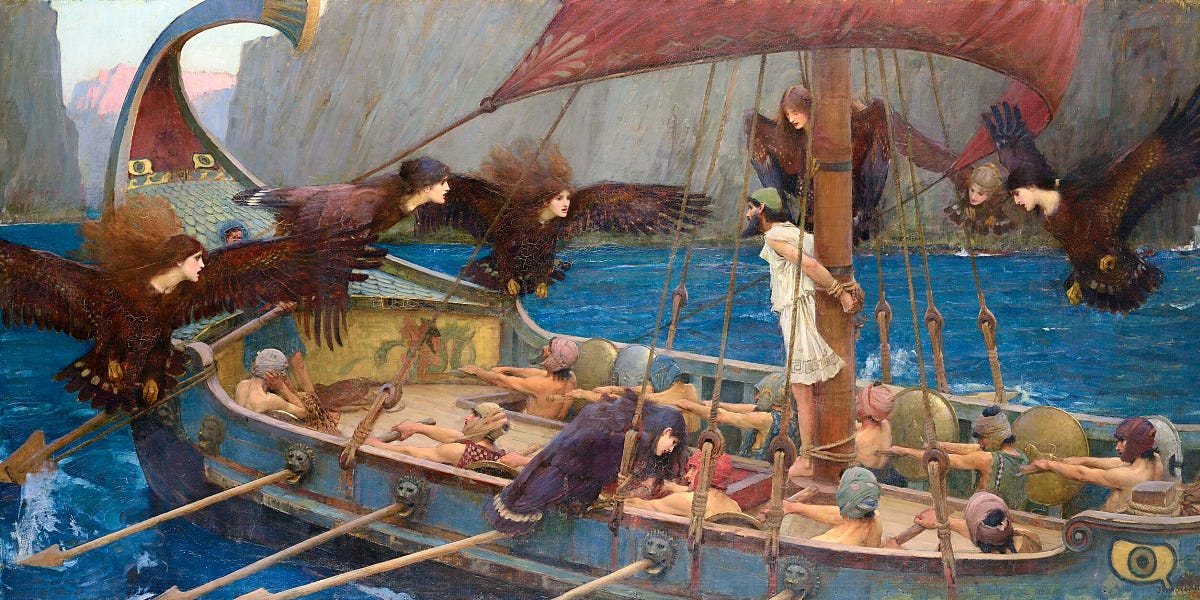
Upon seeing this new series from a favourite writer—and having a few of you write to me about it—I found myself sitting with some new questions. Am I too late? Has my work been rendered null? What is even the point of a book, these days?
Happily, this has all transmuted into something quite galvanising. Enough for me to finally (begin contemplating how I might) step out from the shadows.
But before I continue—hello and welcome to new subscribers! My writing has been rather solipsistic of late. If someone forwarded this to you, wonderful. You can subscribe over at foxwizard.com (I should point out that my museletters are epistolary; personal, reflective, honest, meandering—and not particularly pithy.)
Whilst you’re here, this month I have published two things: episodes seven and eight of the ‘Kindred Spirits’ podcast with my friend John Anthony.
I’ll soon share more details about ꧁ The School of Fox Wizardry ꧂ I teased in the previous museletter I wrote to you.
Finally, Dr. Fox is accepting bookings for 2026. Themes I am called in to assist with include: motivation amidst change fatigue, leading amidst uncertainty, unlocking agency, and performance beyond measure. (These themes tell their own story.)
Thank you for being with me. 🧡🦊
Anyhoo, back to my reverence. I remain immensely inspired by David Chapman, who gallantly writes on “better ways of thinking, feeling, and acting—around problems of meaning and meaninglessness; self and society; ethics, purpose, and value.” Amongst other things. Metarationality, Meaningness, Vividness, Buddhism for Vampires, and Better Without AI (he did a PhD in Artificial Intelligence btw) are the metablogs/books he maintains. David is a large reason why I found myself wending my way to writing my next book for you.
What do I have to show for it? Breadcrumbs. A raven’s feather, and some red thread. A mention in The Ritual of Becoming (2019), a pop-up museletter, and an old substack museletter I sent in 2020 (from before I left substack). That same museletter quoted David immediately after my mention of Mythic Mode.
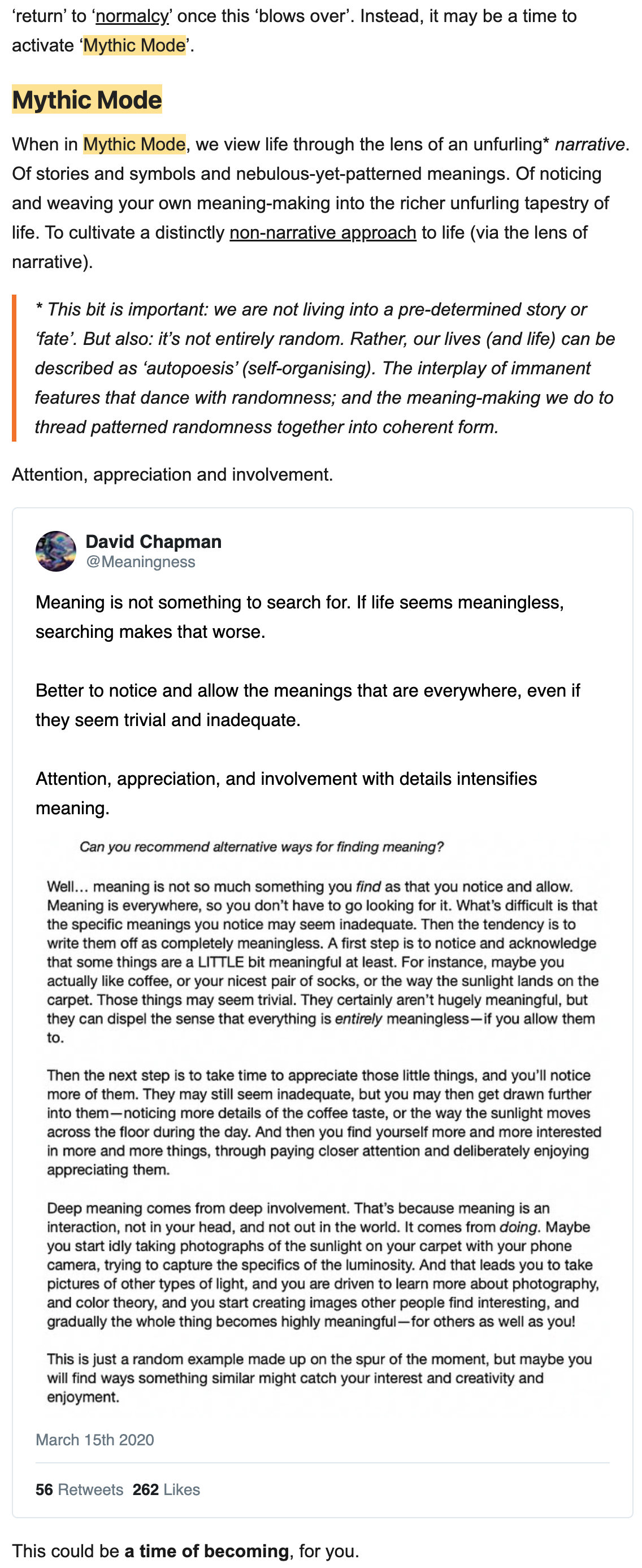
And so when I saw David’s new series on mythic mode, I felt an odd mix of emotions swell up in me. Elation and delight (David’s attention only ever enhances ideas), petulance and lament (why has my writing been so slow? and why have I been so absent from the arena?), trepidation and concern (would this now become a buzzword?).
I’ve landed back to generative delight, but the trepidation is worth unpacking.
Buzzwords
I this with ‘gamification’—a word that came into prominence from 2011. The word itself is inherently terrible, btw. Cursed.
Back then, video games were still considered fringe, and the motivational concepts were either hokey individualistic ‘magical thinking’ types, or the charismatic repackaging of SMART goals and ‘mindset’. I self-published a small book on this (in 2011), offering an alternative perspective (after working part-time as a blood-elf alchemist for a guild whilst completing my PhD). It seemed to resonate.
But by the time The Game Changer (my second book) came out in 2014 the word had become thoroughly co-opted and corrupted by consultants. The richness of world-building and lore, creative constraint, narrative scaffolding, and all the ludic qualities and care that give rise to immersion in both finite and infinite play were reduced to: points, badges, and leaderboards. Weirdly metric-obsessed abstractions, removed from the joy and meaningness of the struggle itself.
To give you a sense: “Exploiting Users By Letting Them Have Fun” is the title of a presentation and book from such times (although the book was re-released from ‘exploiting people’ to ‘engaging people’, as “Research shows when people are engaged they are more productive. That’s why gamification has caught on in the corporate world.”) Bleh.
The Machine always wants more productivity.
Anyhoo, seeing David’s post made me worried that this would happen with mythic mode, too. But since when have I been so cautious? So far, it seems to have survived capture by commodifying consultants. Good folks like my friends Kevin McGillivray and Buster Benson have written of it.
Perhaps I’ve been too protective? Too clandestine and circumspect, I suspect.
Ideas are alive
I’ve shared works-in-progress before, only to have fellow ‘thought leaders’ spin the ideas off as their own.* Not that I claim any ‘ownership’ of ideas. Ideas cannot be owned—they have a life of their own. And they want to be expressed. But released too soon into the wilds and, well: they can become swiftly captured, commoditised and franchised—and thus sapped of their animacy. Subsumed by The Spectacle, then devoured by The Machine.
* My main wish is that they honour the ideas, and do them better. It also never hurts to attribute and honour source. Quite the contrary; it elevates all.
Thus there’s a kind of tender custodial stewarding that some ideas need, first. Or a listening and attending-to. All good storytellers and bards know this.
And so I have been worried that some consultant would hear of my workings of Mythic Mode and then go do it themselves in a manner that diminishes the notion. But even writing this now feels as though I have been acting like an overly protective father, instead of the dancer I once was. How did this happen?
A related aside: for eleven years I have been attending to The Ritual of Becoming—a small component of which involves “Choosing One Word” to serve as a fuzzy contextual beacon to guide one’s own mythopoetic unfurling. But I’ve seen that many folks will bypass the richness of the Ritual to simply ‘pick a word’ for their year, and then post about it on LinkedIn. That element was all too easily commodifiable. But I’ve written of this before.*
* In yet another post where I also reference David Chapman, ha.
It has also happened that I would sometimes take months working to distil a rich concept into a resonant and poetically apt—only to see another thought leader copy-paste my exact words as their own. This has been rather vexing*—not from the lack of attribution, but for the way that facsimiles somehow diminish potency.
* And no, I don’t want to be the guy who litigates and lays claim—that only reinforces the shitty rivalrous dynamics of this attention economy. I instead want to grab them and shake them into their own genius.° And then hug them and have them feel supported in doing so.
° I read a passage from Luke Burgis today that is quite apt. “Perhaps the recently canonized saint, Carlo Acutis, a young Italian computer programmer who died at the age of 15 from acute promyelocytic leukemia, offered the best probe (which is an inverted question) for our age when he said: ‘All people are born as originals, but many die as photocopies.’”
Hence why I tend to obfuscate, and write in a manner, pace and style that is my own. A way that goes against the grain of default advice—where everything must be as crisp and clear and sterile and homogeneously optimised as possible, indistinguishable from the slop dispensed by The Great Plagiarism Machine.
I’m also reminded of the sensibilities that Tyson Yunkaporta spoke of in a podcast episode once upon a time.
“I don’t know, I try to avoid naming anything. And I try to avoid making too much sense, and I try to say things a bit differently every time and to mix it up. And I'll make points that you can’t put together. I do that quite deliberately because I don’t want the things I’m thinking or working on to become an ideology or a brand, or something that people can use as a name. I have seen that happen before with a few things I’ve done: People have grabbed it, and then it’s become their thing. You’ve got to avoid that packaging and repackaging of ideas and let these things be free-range.” (source)
There is a requisite wiliness that is required for courting ideas in the wild, and in honouring their poiesis.
Generative ambiguity
My own attempts to write Mythic Mode have so led me into my own unravelling.
As you know, my last book—How to Lead a Quest—posited the notion of meaningful progress, as distinct from the delusion of progress.
I used to call myself ‘a trickster’ back then; cute, but not the best way to dance with Trickster, lol. Trickster be like O RLY? Anyhoo, such transgressions resulted in me becoming blursed by the very subversive magics I was channelling. The question of ‘meaningful progress’ involuted back unto me.
I began to question everything—and most everything withered in response. No system of meaning could hold, and the things that once motivated me no longer held any potency or charm. Which is just wonderful for someone who reluctantly (yet very effectively) plays the role of motivational speaker, haha. The window of disenchantment lay wide open—and this time I walked through.
One could say this maps to what David Chapman (building on adult developmental psychologist Robert Kegan’s work) might call ‘the nihilistic gap’, which “generally provokes anxiety, rage, and depression, and is not a good place to get stuck.”
“Many of the people I care about most, and find most interesting, are STEM-educated refugees from ideological rationalism. They’ve mastered rationality, they’ve seen through it—and many now are stuck. Systems cannot provide them with meaning; but neither, it seems, can anything else. Many fall into crippling nihilistic depression... This is awful.”
Ha, yeah, it is/was. Thank you to those who stayed with me through these times. It’s been... weird. And will continue to be. The last year has seen me come through—there is hope for all of us.
Besides: no time spent being lost is ever wasted.
There’s a line from the Nigerian-American writer and photographer Teju Cole that has offered some solace to me as I go about this book in the pace it demands.
“How to sustain for as long as possible the ‘I don't know what this is’ phase of the work. How to keep the search focused but open at the same time.”
I feel I have done well with this. The work demanded it.
Here’s another line from Teju that I have used to fend off well-intended editors who wanted the book to work to a ‘plan’.
“In a culture where you have to describe your ‘project’ before you’ve even begun work on it. Where explanation is the coin of the realm and sensibility is outmoded. Look. For a long time.”
Which, of course, links to the very same thing that David Whyte speaks of in his prose on ‘ambition’. “Ambition abstracts us from the underlying elemental nature of the creative conversation while providing us the cover of a target that has become false through over-description, overfamiliarity or too much understanding. The ease of having an ambition is that it can be explained to others; the very disease of ambition is that it can be so easily explained to others.”
This book I am writing for you has resisted easy explanation.
Into the dark forest
David Chapman writes of how “moving conclusively beyond systematicity inevitably induces feelings of loss—loss of your previous way of making sense of the world, and of your previous, systematic self.” There may come a time when all of your systems, motivations and ontological models fall away for you, too. And, like Chapman, I am hoping that the book I am writing will be a guide for you. The guide I wish I had.
I say that the pursuit of this book has led me into the dark forest (a place where, blessedly, we lose our way) and into the wilds. I’ve found much solace and fire in writers like Martin Shaw, Sophie Strand, and Michael Meade. The grief I finally began to express (for the loss of a father, and for our world and ecology) opened me up to writers like Joanna Macy and Francis Weller.
It was poetry, myth, time in nature, warm friends (and maybe a bit of plant medicine) that lifted me out of the darkness and into the dappled half-light.
Poets like David Whyte and Rainer Maria Rilke work profound magic upon me, now. I’ve also since found myself much more open to flirtations with the animate world. I am in deep agreement with Josh Schrei when he says: animism is normative consciousness.
“For 98% of human history—over 10,000 generations—our ancestors lived, breathed, and interacted with a world that they saw and felt to be animate—imbued with life force, inhabited by and permeated with beings with which we exist in ongoing relation. This animate vision was the water in which we swam, it was consciousness in its natural dwelling place, the normative way of seeing the world and our place in it. It wasn’t a theory, a philosophy, or an idea. It wasn’t, actually, an ‘-ism’. It was direct, felt experience. It was, simply, how things were.”

I contend that this is compatible with what David Chapman aptly asserts:
“The mythic mode supplies purpose, a critical ingredient, for all the other modes. Reasonableness can see only mundane, conventional purposes, which are ultimately unsatisfying.
Rationality only works by excluding consideration of purposes. They have to be supplied externally, and as sterile abstract formalisms. Meta-rationality reflects on purposes, but relies on the mythic mode for their inspiration.
The mythic is also the easiest mode from which to access the complete stance. That is the accurate and enjoyable way of engaging with meaning and meaninglessness. The mythic mode, like the complete stance, plays with pattern and nebulosity, boundaries and connections.”
It was that big nebulous sense of purpose I needed to once again find. I had written on how ‘purpose’ itself being a word that is also all-to-easily commodifiable. Yet somehow, in a decentralised, contextual, relational, embodied and soul-stirring way, a sense of purpose can emerge once more.
We just need to beware our attempts to render it into ‘explanation’.
My questing in the dark forest generated the insight-cascade that resulted in my becoming metacrisis and collapse-aware. Or perhaps it was the other way around?
This is not a fun realisation to have, and I am empathetic to those who would rather persist in denial. Jan Andrew Bloxham puts it well:
“Becoming collapse aware is like imposing a cancer diagnosis on humankind—children and babies included. It renders long-term planning surreally moot, Children of Men style. Building anything lasting becomes pointless. It’s looking at everyone around you go about their business and thinking, ‘What are you doing? Do you have any idea what is coming?’.”
Minds like Daniel Schmachtenberger, Jem Bendell, Dougal Hine, Nate Hagens (and many more) have made this feel less maddening. Also, Sophie Strand recently wrote a ‘Collapsollogy Reading List’ that is worth attending to.
It became clear to me that the way through this metacrisis won’t come from the discovery of ‘new facts’. We don’t need more evidence of global heating or species extinction or ‘information’ about our predicament. Nay, it will it come via The Great Turning (or some sort of messy equivalent). Which is perhaps why I feel drawn to minds like Bill Plotkin, Bayo Akomolafe, Vanessa Androtti, Nora Bateson, Jonathan Rowson,* Tyson Yunkaporta, and many more. They each have the quality of feeding the leaks. There’s an altogether animate and more-than-rational quality they each bring.
* Jonathon’s recent musings on ontopoetics is wondrous. The subtitle: “On the intellectual dignity of believing we are in conversation with the world.”
This recent episode from Alexa Fimenich on the Lifeworlds podcast is an exquisite example. Rilke’s poetry thrums with invitation, beauty and terror.
I listened to this whilst swinging kettlebells at the gym. It moved me to tears, and I had to sit down. I was literally floored.
Yet I also know that someone else could listen to the same poetry and (somehow!) remain unmoved. I know because that was me, a decade ago. I would have intellectually delighted in a clever turn of phrase, and I would have registered intended emotional affect—yet it wasn’t deeply felt.* Not like now.
* Back when I was operating purely rationally, I dismissed feelings as interference—even found this dismissal amusing. That capacity to feel into poetry, myth, and meaning had to be recovered. It’s one of the gifts this work has demanded of me.
Which is why I sometimes toy with the following prefix-provocation to the book title:
Perhaps you are ready for
MYTHIC MODE
Because not all of us are, in fact, ready for Mythic Mode. So many of us are caught within the grip of what we might call Machine Mode.
Machine Mode
...is a mode that would have us orient ourselves to life mechanistically. Our motivations reduced into that which can easily be explained, measured, ‘optimised’ and rendered more ‘efficient’. Systems of atomic habits, Pavlovian triggers, everything tracked. In time, we would find ever more nuanced ways to optimise our own lives—measuring, monitoring and even ‘hacking’ our own biology so as to improve our performance within narrowly defined metrics.
We would also increasingly use artificial intelligence and other dehumanising technologies to achieve our goals faster, learning via summaries and communicating via scripts, promptly prompt-engineering our way to some prefabricated notion of ‘success’. We would, in effect, minimise all friction—and in so doing, minimise the messiness of community, human interaction, and our own development.
We would, effectively, groom ourselves to become the perfect cogs in The Machine; thralls to M̴̬̩͑̇o̵̫̩͇̘͈̲͑̐̀̔̉ļ̶̢̬͈͔͇̤͎̲̓ͅô̶̡͉̮̮̖̖͕̩̝̝̼̙͙͈̞̇͆̿̄̆̔́̈́̽̅̋̃͝c̸͇̙͍͉̭͈̍͒̎h̸̭̫͊͗̐̄͊̊, The Great Devourer. Sacrificing everything we love* in order to obtain what we think we want. Which will never be enough.
* Our (inner) children, our health and wellbeing, time, nature, and the very substrate of Life itself.
Machine Mode is hyper-rational. It is a mode that seemingly works well, within the paradigm of late-stage capitalism. It’s a mode that many of us adopt in order to ‘get ahead’ (or really, to simply survive).
Organisations are locked into the logic of Machine Mode. It’s a mode that perpetuates ‘the curse of efficiency’ that I write of in How to Lead a Quest. It’s a mode that generates momentum—and momentum inhibits reinvention. It’s also conducive to the dark triad, warlocks, or Venkatesh Rao’s old Gervais theory (wherein sociopaths rise to the top).
Machine Mode also has us perpetuate lemon markets.
Frank Chimero writes of this. One example being social media.
“Your feed is now professional content creators, low-effort podcast video clips, algorithmic filler reaction videos, stand-up chaff, and animals. Good ideas don’t happen frequently enough to satisfy the pace of the algorithm, so many have pivoted to newsletters or stopped posting.”
He further adds:
“What makes the Market for Lemons concept so appealing (and what differentiates it in my mind from enshittification) is that everyone can be acting reasonably, pursuing their own interests, and things still get worse for everyone. No one has to be evil or stupid: the platform does what’s profitable, sellers do what works, buyers try to make smart decisions, and yet the whole system degrades into something nobody actually wants.”
This is what complexity practitioners might call a ‘multipolar trap’.
To illustrated this point, A16Z has recently funded “Doublespeed”—a hot new startup that seeks to ‘Automate Attention’ with ‘Bulk Content Creation’ via artificial intelligence and the equivalent of phone-farms.
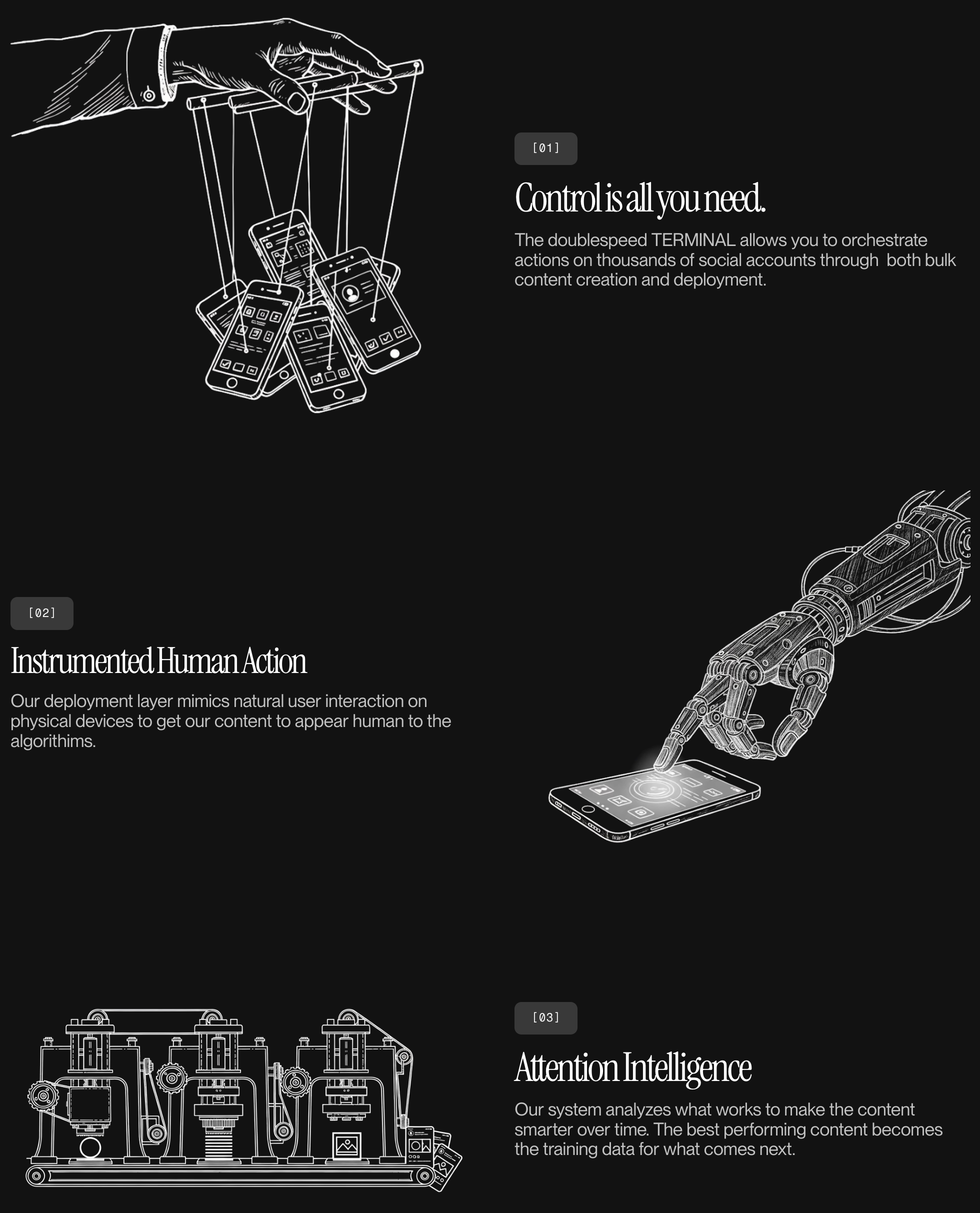
“Never pay a human again,” this startup proclaims (as if this were a good thing). “It's never been easier to create and deploy content without human cost.”
This is The Machine.
And it doesn’t only want your attention—it wants to distort your values, too.
Paul Kingsnorth writes of this extensively in Against The Machine—on the Unmaking of Humanity. And Simon Wardley recently shared one of his great little dialogues on this very matter.
X : Can you summarise the issues of AI for me?
Me : No. AI is a field. However, I'll guess that you actually mean large language models / GPTs?
X : Yes
Me : GPTs are a non kinetic form of warfare designed to embed the values of a small number of people into much wider communities by capturing the process of decision making. The delivery mechanism is the appearance of helpfulness i.e. coherent and authoritative arguments. The payload is helplessness and the creation of a new theocracy.
X : That’s not what I was after. I was thinking copyright and existential risks?
Me : Do you mean frontier “AI”?
X : Yes.
Me : Frontier AI and copyright are distraction mechanisms, probably in part funded by the vendors themselves, to divert your attention from the real dangers of embedded values caused by these forms of warfare.
X : Stop calling it warfare.
Me : Would ... “Beware of geeks bearing gifts?” ... be more helpful?
X : What about the power issues?
Me : It’s all about power, always has been.
X : I was talking environmental cost.
Me : Another distraction, to avoid discussing the only thing that matters.
X : Copyright, frontier AI and environmental costs are not distractions!
Me : They are things you care about?
X : Yes.
Me : Ah, they are things you value. Well, I only have to wait and eventually your values will be those that the vendors value. Your ability to reason will be confined by the tools, language and medium those vendors control. If they care, you will care. If they don’t, problem solved. And you won't even notice.
X : I’m not some automaton.
Me : You missed the word ... “yet”. You will be, quietly typing away on your favoured GPT asking it how you should think about this discussion. But don’t worry, it’ll tell you that you’re still in charge and making really excellent points.
Gurdjieff would argue that we are already machine. A machine that does not know itself. And “the work” of The Fourth Way is to be present, cultivate consciousness, remember ourselves, and to live in our essence. Artificial intelligence is... not going to help with this.
We are going to need different modes to turn to. The mythic mode is one of them. One in which we know ourselves to be situated within a warm relational web (where everywhere and nowhere is centre). A mode in which we remember the essence of infinite play James P. Carse writes iof:
“No one can play a game alone. One cannot be human by oneself. There is no selfhood where there is no community. We do not relate to others as the persons we are; we are who we are in relating to others. Simultaneously the others with whom we are in relation are themselves in relation. We cannot relate to anyone who is not also relating to us. Our social existence has, therefore, an inescapably fluid character... this ceaseless change does not mean discontinuity; rather change is itself the very basis of our continuity as persons.”
Momentum inhibits reinvention. But sometimes life throws a spanner, things fall apart, and the machine mode stops working for you. Your body rebels from burnout, a loved one becomes unwell, or for some unknown reason you find yourself listless, despondent and at a loss as to what to do.
THIS! This is mythic invitation. This is the window of disenchantment I am writing for. A sacred opening wherein you might Slip The Machine, Find Your Way & LARP Your Best Life.*
* That’s the working subtitle for Mythic Mode, btw. The LARP bit is sincere-irony. I know how it sounds, but there’s great depth to living and acting, and of having a role to play in a wider web of relations. It translates to a listening and authentic relating practice, too.
These portals to disenchantment don’t stay open too long. The Machine is good at recruiting us back to its cause. But there’s a crack—something we might slip through.
From David, one more time.
“The mythic mode not only tolerates, but actively enjoys, contradiction as well as ambiguity. [...]
Reasonableness is not comfortable with contradictions, and will try to change the subject, or obfuscate when they can’t be avoided. Rationalism, of course, rejects contradictions outright. It is founded on the Law of the Excluded Middle. ‘It will not be possible to be and not to be the same thing,’ is one way Aristotle put it. Rationalism insists that every possible proposition is either absolutely true or absolutely false—in the face of constant evidence that nearly all of them are neither. It is only at the stage of meta-rationality that we regain skill in juggling contradictions—and delight in them.
Binary conceptual opposites, and their middles or paradoxical exceptions, fascinate the mythic mode. That which is neither alive nor dead, but somewhere between; someone who is both a human and a goddess, or both a human and a bear; entities that are simultaneously invisible and seen.”
Fascinate the mythic mode they sure do! I am so grateful for his writings, and minds who likewise share their knowledge, wit, wisdom and insight so generously.
Trickster wants movement
And ideas want to be expressed.
If you don’t attend to your Muse—they’ll move on to another vessel. The ideas will emerge, one way or another. Earth will dream through us.
A reason this book has taken me so long to write is because I needed to lose myself, so as to find my way through. But I also feel that, for the first time in years, I now have a tentative courage to start bringing it to life more publicly.
The metacrisis is real and accelerating—I’m clear-eyed about the darkness we’re in. But I also sense an emergent role to play in this threshold time. I wish such clarity for you, too.
We are living in a time betwixt worlds, and we each have a roles to play. There is room for all of our voices in this choir.
And so instead of hiding in shadows, I shall now hide in plain sight. Camouflaged, perhaps. But more visible for those who know where to look. 🦊
Member discussion