
2026 will be known as “The Year of the Curious Squid”
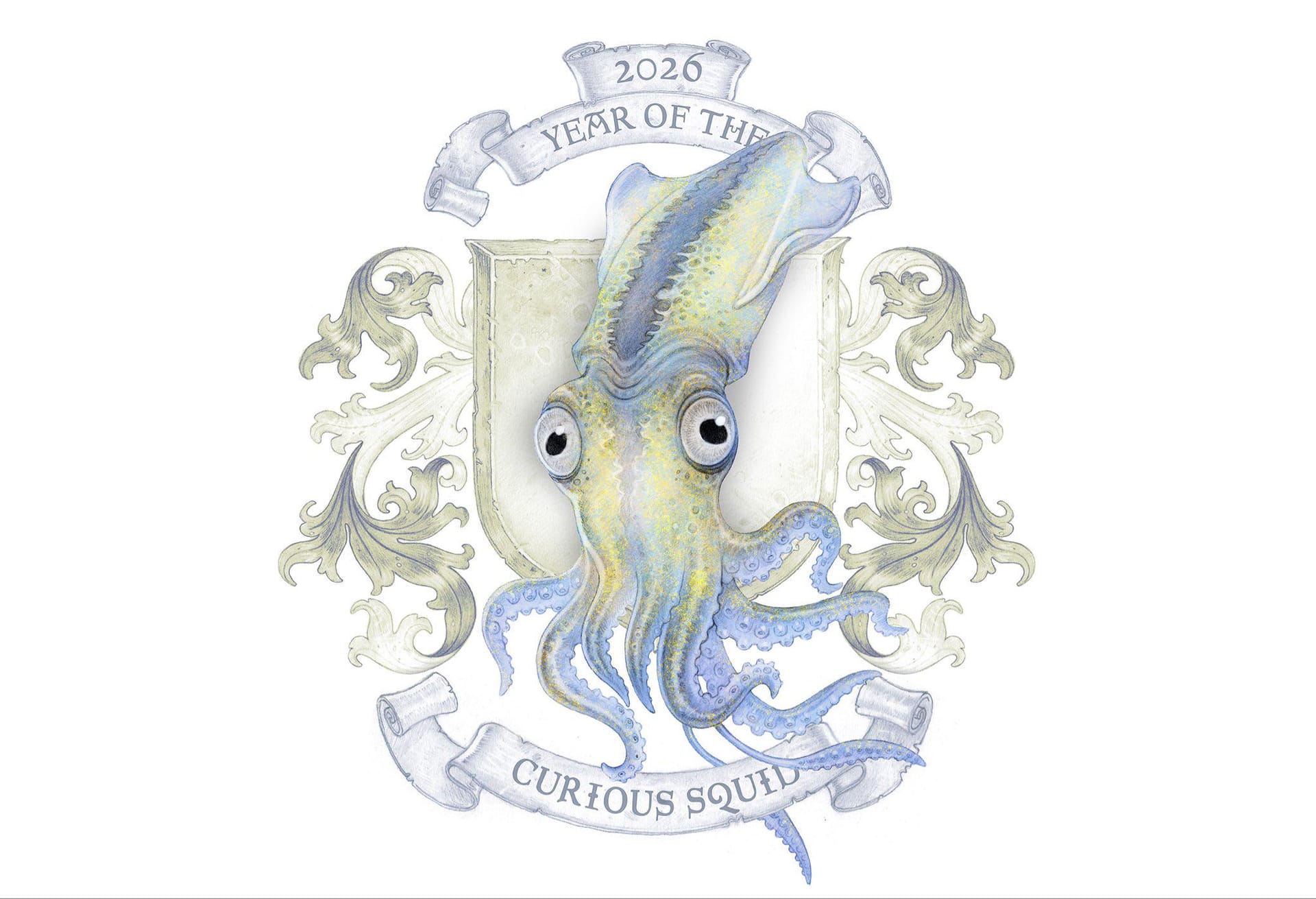
In 2004 Sir Terry Pratchett—author of the Discworld series—came up with a list of year names ‘long enough to last a fair while’. This list is held by Terry’s long-time friend and business manager Rob Wilkins, and is not publicly available. Each year is illustrated by long-time collaborator Paul Kidby.
Here’s a list of previous years
- The Year of the Prawn (2005)
- The Year of the Signifying Frog (2006)
- The Year of the Reversed Ptarmigan (2007)
- The Year of the Three Roses (2008)
- The Year of the Pensive Hare (2009)
- The Year of the Happy Goose (2010)
- The Year of the Complicated Monkey (2011)
- The Year of the Second Inception (2012)
- The Year of the Frog Ascendant (2013)
- The Year of the Reciprocating Llama (2014)
- The Year of the Spinning Mouse (2015)
- The Year of the Sneezing Panda (2016)
- The Year of the Backwards-Facing Artichoke (2017)
- The Year of the Justifiably Defensive Lobster (2018)
- The Year of the Incontrovertible Skunk (2019)
- The Year of the Condescending Carp (2020)
- The Year of the Beleaguered Badger (2021)
- The Year of the Lachrymating Leveret (2022)
- The Year of the Querulous Megapode (2023)
- The Year of the Moribund Aardvark (2024)
This year (2025) has been The Year of the Luminous Lemur.
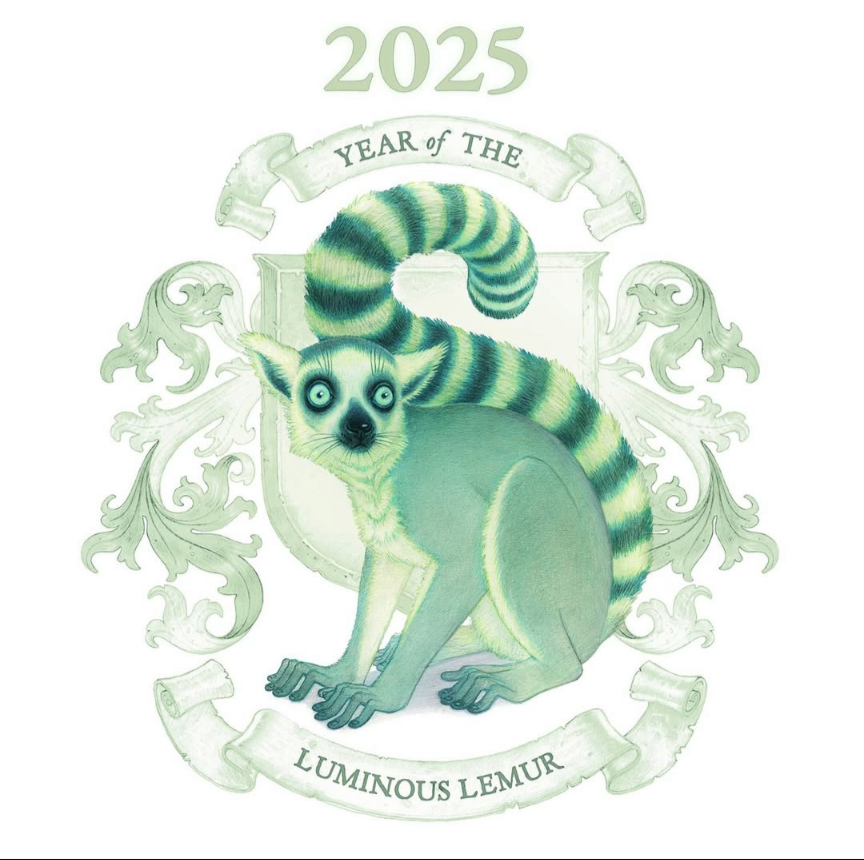
If I allow my mind to contemplate the qualities of The Luminous Lemur and retrofit them to our own semi-shared narrative, it’d go something like this.
Luminous
Luminescence isn’t bright or flashy. It doesn’t show off, or herald “Huzzah! I’m here for sexy times.” Nor is it a way of flexing “I’m poisonous” like some brightly coloured frogs might.
Luminescence just glows. And this is a quality you’ll only really notice in the dark.
And it has been a dark time for anyone paying attention. And in such times, the temptation would be to dim your light, keep your head down, mind your own business. But The Luminous Lemur was, perhaps, a reminder for us to instead glow.
This is different from shining. Shining is about reflection—it requires an external source of light. Performers shine from the attention they receive. We shine when there is brightness.
Luminescence, on the other hand, is emanation. The light comes from within. A glow is softer, steadier, and more enduring than shine. It doesn’t require polish.
Lemur
Lemurs are fellow primates who evolved independently from monkeys and apes. Lemur societies are also female-dominant, which is a refreshing inversion from the standard primate hierarchy. They are very social, too.
Lemurs, like all liminal creatures, have an enhanced perspectival acuity—they’re able to stay deeply attuned to the periphery. But they’re also not making a fuss about it.
Again, to retrofit some wisdom, it seems to me that 2025 has been a time in which many of my own friends migrated to private signal groups. These are more intimate, more social, and more real than the antics that occur in the harsh light of the open web.
The Luminous Lemur has, perhaps, offered some of us the encouragement to find our own glow away from the fabrications of social media, to participate within a different kind of social web, and to foster a greater acuity for the subtle and unseen. Certainly for myself, and for many of my own friends, there is a tentative and furtive exploration of the mythic and more-than-rational (other & under) worlds—and this has been nourishing for the soul.
And now: contemplating the qualities of “The Curious Squid”
I have thoughts on this, pertaining to supple sapience, and of cephalopod curiosity (as distinct from feline). This has also stirred up memories from one of my favourite books of recent times, The Mountain in the Sea.
But at the same time, I am trying to learn how to do short-form. As you know, I cast big spells. This month I’m experimenting with the heretical notion: what would it be like to write pieces that are less than 1,000 words? I failed yesterday. I also grow a little weary of my own solipsism.
And so I wonder: what qualities do you sense The Curious Squid might offer to us?
Member discussion