
e22 // Knowledge of Curses
This is the final episode of “Season One” of the foxwizard podcast. In this episode I unburden myself of a concept I have been wanting to share with you for some time:
- Knowledge of Curses. That is, malefic punishment or consequence that endures until either broken or lifted (due to certain conditions being met). This isn’t my magic, but I am bard enough to know of it. I’d never dabble in such; not even hexes. You need to be careful with what you weave, and where you invest your energy. Such things bind. Yet still: it’s good to know of such, so that you can go gently.
- The Curse of Knowledge. This is a cognitive bias wherein we assume others have the same familiarity with specialised knowledge as we do. I tend to believe we must relate to everyone horizontally—no one is greater-than or less-than anyone else. This means I tend to treat everyone as a peer (which only exacerbates the curse of knowledge). And whilst it is true that we are all kindred spirits, not everyone likes bafflement. And yet there is such a thing as teacherly authority. Good teachers have this. And the charm of teacherly authority is the orientation towards redundancy—a good teacher wants to be surpassed by their student, for it means they have fulfilled their role well. I’d like to be a good teacher. Or at least: better than I have been.
- Cursed Knowledge. Just as there are some concepts that resist awareness (antimemes), so too there exists knowledge that isn’t merely additional content for the mind[^ Tidbits and ‘new facts’ that fit within existing paradigms.] but rather something that reconfigures the substrate of perception itself, collapsing possibilities that were previously open. In previous episodes, whilst I was still questing in the dark forest, you might have heard me speak of the insight-cascade that had me finally realise “The Meta-Crisis.” This is cursed knowledge.[^ Once you know it, you cannot return to the innocence of your previous cosmology because you’ve become complicit with what you now understand. You’re no longer an external observer of a fact—“just asking the questions”—you’re enrolled as a participant in its reality. And also: you’re responsible for what you know now, too. Cursed knowledge doesn’t sit neutral in your mind. It’s not merely interesting—it inhabits you. And you cannot un-know it; you’re bound to the same threads that led you to its realisation.] It is ontologically destabilising, snuffing illusion and hope. It’s also something people don’t want to hear, or engage in—they’ll have subconscious cognitive defences to protect against discomfort and dissonance. But hey—there’s an accord one can arrive at. Something post-tragic. And you’re not alone. And it’s not all on you alone, either. Oh and who knows—what seems a curse may become a blessing. Amor fati et al.
Note: this is actually quite an upbeat episode. I know it might not sound like it is, what with the title and content thus far. But really, it is! ᐠ( ᐛ )ᐟ
This episode was recorded on the 18th of December 2025 whilst sitting by a pond at the edge of a forest at the back of a property within lunawanna-allonah.[^ Also known as Bruny Island; a small island off the island of Tasmania (itself being a small island off the continental island of Australia).] You’ll hear plenty of bird song, and some frog ribbits, too.
I was staying with my friends Paul and Annie; ostensibly for a wizardly writing retreat. And I did get a lot of writing done, including some conceptual breakthroughs that allow for many things to finally coalesce. It was also a blessing to be (mostly) away from internet for a week.
What here follows are the ‘show notes’—links from the many references I casually drop in this warm and extended soliloquy. My curse of knowledge means that, in the moment, I assume you mostly know what I am talking about. (•᷄ᴗ•᷅ ᵕ)
Show notes
I’ve added approximate time-stamps to each.
~12mins, 11 seconds
“Atheists are just modern versions of religious fundamentalists: both take religion too literally.” I reference Nassim Taleb a lot. His aphorisms (mostly) ‘bang’, as I believe the children say.
This, in turn, brings to mind James P. Carse’s wondrous book, The Religious Case Against Belief, which posits religion as poetic, infinite play. This also parallels David Chapman’s comments on how ‘eternalism’ (the sense that everything has a fixed and clear-cut meaning) is a fantasy. I think (?) a long time ago I spoke of similar such things in the labyrinths of reason.
~13 mins, 42 seconds
“Cognitive Atrophy” is a concept I find myself referencing a lot, these days. And the analogy that Zachary Stein uses is brilliant. Here’s a link to the video of the conversation Zachary had along with Nora Bateson on The Great Simplification with Nate Hagens (the link will jump straight to the piece—but as always, the whole conversation is worth it).
The crude gist is that cognitive atrophy is what we get if we rely on AI to do our thinking for us. It’s like going to the gym, but instead of lifting weights you strap into an exoskeleton suit that can lift the weight for you. So while, yes, you are lifting weights—and probably more than you normally could—relying on the exoskeleton will see your own muscles wither away.
The message here is not “don’t use it” but rather to be more considered as to when you do use it. It’s a kind of magic, and all magic involves some kind of exchange.
~19 mins
“Not doing any magic at all was the chief task of wizards—not ‘not doing magic’ because they couldn't do magic, but not doing magic when they could do and didn’t. Any ignorant fool can fail to turn someone else into a frog. You have to be clever to refrain from doing it when you knew how easy it was. There were places in the world commemorating those times when wizards hadn’t been quite as clever as that, and on many of them the grass would never grow again.” ― Terry Pratchett, Going Postal
~26 mins
I reference Ursula K. Le Guin’s Bryn Mawr Commencement Address (1986) where she talks of Father Tongue and Mother Tongue.
~31 mins
I referenced (from memory) a “quote” from Krista Tippett and On Being. This may have been something I heard her say when she visited Melbourne (I can’t find the source). But essentially, I recall her kindly eschewing the thought of interviewing anyone with ‘too much conviction’. Hers is a style that orients away from epistemic closure, and she is exquisitely talented at drawing people toward articulating what they haven’t ever quite put words to before. This requires a certain openness, which conviction precludes.

~34 mins
There I go, (slightly mis-)quoting Wendell Berry’s Our Real Work, again.
I also reference The Cost Of Reading Wendell Berry, a wonderful piece by Hadden Turner.
“It is painful, at times very painful, reading Wendell Berry. There you are, sitting down comfortably to read what you think will be a quaint and nostalgic treatise on the virtues of horse-drawn tools, when suddenly you are confronted with Mr. Berry forcing you to reconsider your relationship with speed, efficiency, and the fast-paced life. Or perhaps you are settling down at night in the warm glow of your lightbulb to read an essay before you go to bed, only to read how Mr. Berry has committed to not writing in the evening as that would mean he has to use electric lights. This, he argues, would make him complicit in the mountaintop removal coal mining for electrical energy generation that he has protested so vehemently against. Being confronted with our complicity in the degradation, damage, and at times, destruction of the good which is all around us is painful. For sure, then, it can be a highly uncomfortable experience reading Wendell Berry. But the pain is why you should.”
~37 mins
My “cult classic” book How to Lead a Quest turns 10 today.
~42 mins, 30 seconds
I talk of my friend Vas Clementine and his Remembering Story Medicine events.
~43 mins
I mention my friend Mykel Dixon and his WILD work.
✧。٩(ˊᗜˋ )و✧*。
~43 mins
I also talk of my friend John Anthony and reflect fondly on 10 episodes of Kindred Spirits. You can watch and listen to them all at kindredspiritspod.substack.com
~47 mins, 30 seconds
I mention The Law Of The Excluded Middle. This was something I was reminded of recently in David Chapman’s essay on Seeing and Doing Mythically.
“The mythic mode not only tolerates, but actively enjoys, contradiction as well as ambiguity.
[...]
Reasonableness is not comfortable with contradictions, and will try to change the subject, or obfuscate when they can’t be avoided. Rationalism, of course, rejects contradictions outright. It is founded on the Law of the Excluded Middle. “It will not be possible to be and not to be the same thing,” is one way Aristotle put it. Rationalism insists that every possible proposition is either absolutely true or absolutely false—in the face of constant evidence that nearly all of them are neither. It is only at the stage of meta-rationality that we regain skill in juggling contradictions—and delight in them.”
~53 mins, 30 seconds
I share my appreciation for Josh Schrei and The Emerald podcast. In particular, a recent episode On Mythic Burdens and Cosmic Supports was just what I needed to hear. I recently met with Gabrielle Feather in Lutruwita (a new friend from the interwebs) and she expressed much the same.
~56 mins
I mentioned the nihilistic gap again. Here’s a short post on overcoming post-rationalist nihilism, if you happen to be amidst such.
~57 mins, 30 seconds
I make reference to a horizonal disposition, which I wrote of in a horizonal museletter.
~1 hour, 3 minutes
I hat tip to Dave Snowden once again. If you don’t mind warranted grumpy and occasionally polemic vibes, it’s worth following Dave to see the many skirmishes he engages in on LinkedIn. He has a bright mind and a warm heart.
Or better yet, eschew social media. (Except for slow social media.)
~1 hour, 7 minutes, 40 seconds
I went grim-but-clear-sighted, referencing how many of the elders in the environmental movement have been saying that it is too late. I remember listening to Joanna Macy in conversation with Jessica Serrante with Kim last year and, well, even finding this link for you brought me to tears again. Ours is a society that is good at ignoring the wisdom of the elders (<– good article btw).
It stands to reason, as this post articulates. But notice how, if you go to read this article, your eyes might glaze and your mind might seek distraction. That might be your cognitive defence in action. It’s a lot to process. Even more to metabolise. Heavy, “cursed” knowledge. And I am not sure I would wish it upon folks any more; folks will arrive to it, in their own way. One way or another.
This came to mind when I listened to Jasmine Sun in conversation with Celine Nguyen.
~1 hour, 15 minutes
“[...] I have seen all those articles that are like, culture is stagnating. It's in decline. Like literature is worse than it was in the past. Art is worse than it was in the past.
And I think there’s this real like epistemological problem trying to figure out if that’s true.
Because it’s like, I wasn’t alive in the past when things were supposed to be good. So I’m trying to compare, I don’t know, like me as a baby in the 90s to like me now as an adult in the 21st century.”
This makes sense. The topic was culture, but also: younger folk won’t know a world lush with diverse insects and birds—they only know what they know. These are our shifting baselines.
And is it ‘fair’ for them to know of heavier things? Of a grim future? I don’t know. This is probably why, in wiser cultures, some knowledge is protected or hidden.
Last year I gave a lecture to a room of bright young minds at The Liveris Academy. And it left me realising: young minds need the story, the hope, the dream. We do too. And... some of us also need to be willing to contend with the reality at hand.
~1 hour, 17 minutes, 40 seconds
All of this necessitates a shift in consciousness. A re-opening of The Eye of Value we all have (to quote from the composite David J. Temple in First Principles and First Values of Evolving Perennialism, p. 71). But it needs to be done with deft acuity and attunement—too direct, and people shut down.
The trouble with cursed knowledge is that you feel the need to share it. The trouble with cursed knowledge is also that people don’t want to hear it. And they’ll go to great lengths to avoid discomfort and cognitive dissonance. This can be exacerbating, but it can be transmuted.
Dougal Hine writes that “[Ivan] Illich used to say that hope is ‘remaining open to surprise’. Not assuming you know the end of the story.”
And, in Finite and Infinite Games, James P. Carse reminds that whilst “surprise causes finite play to end; it is the reason for infinite play to continue”.
“The paradox in our relation to nature is that the more deeply a culture respects the indifference of nature, the more creatively it will call upon its own spontaneity in response. The more clearly we remind ourselves that we can have no unnatural influence on nature, the more our culture will embody a freedom to embrace surprise and unpredictability.”
This, to my sensibilities, speaks very much to the “surrendered participation” inherent to the concept of wyrd; the practice of engaging in the act of your own (and our collective) becoming. To shape fate by accepting what cannot be changed whilst acting within what can.
~1 hour, 18 minutes
I reference a piece from a recent episode of The Integral Stage, in which Layman Pascal enjoys a conversation with Alexander Love on A Post-Tragic Worldview. Here are two choice quotes.
From Layman:
“[...] sometimes I’ll talk to people who are a little bit younger than me, and they’re worried about how we’re gonna help with this and how we’re gonna solve the meta-crisis. And you want to just say to them, look, we’re all going to die. The project is going to fail. Doesn’t mean we shouldn’t do it.”
From Alexander:
“And so, you know, there’s a way in which we can see that this process is vast, so maybe it can lead to a sense of insignificance. On the other hand, we have the option to plant these fantastic seeds of possibility that really change people.
Even in the smallest of interactions, we don't need the biggest map to make the biggest change. I think we just need to learn how to love each other when we disagree. That becomes a seed for how the world’s going to unfold for the next 14 billion years.
I feel like there’s a way of participating in that forward movement of seeds that’s related to maybe feeling insignificant. Sort of letting all the potentially negative feelings drop through oneself.”
Whilst recording this I heard the call of a Swift Parrot.
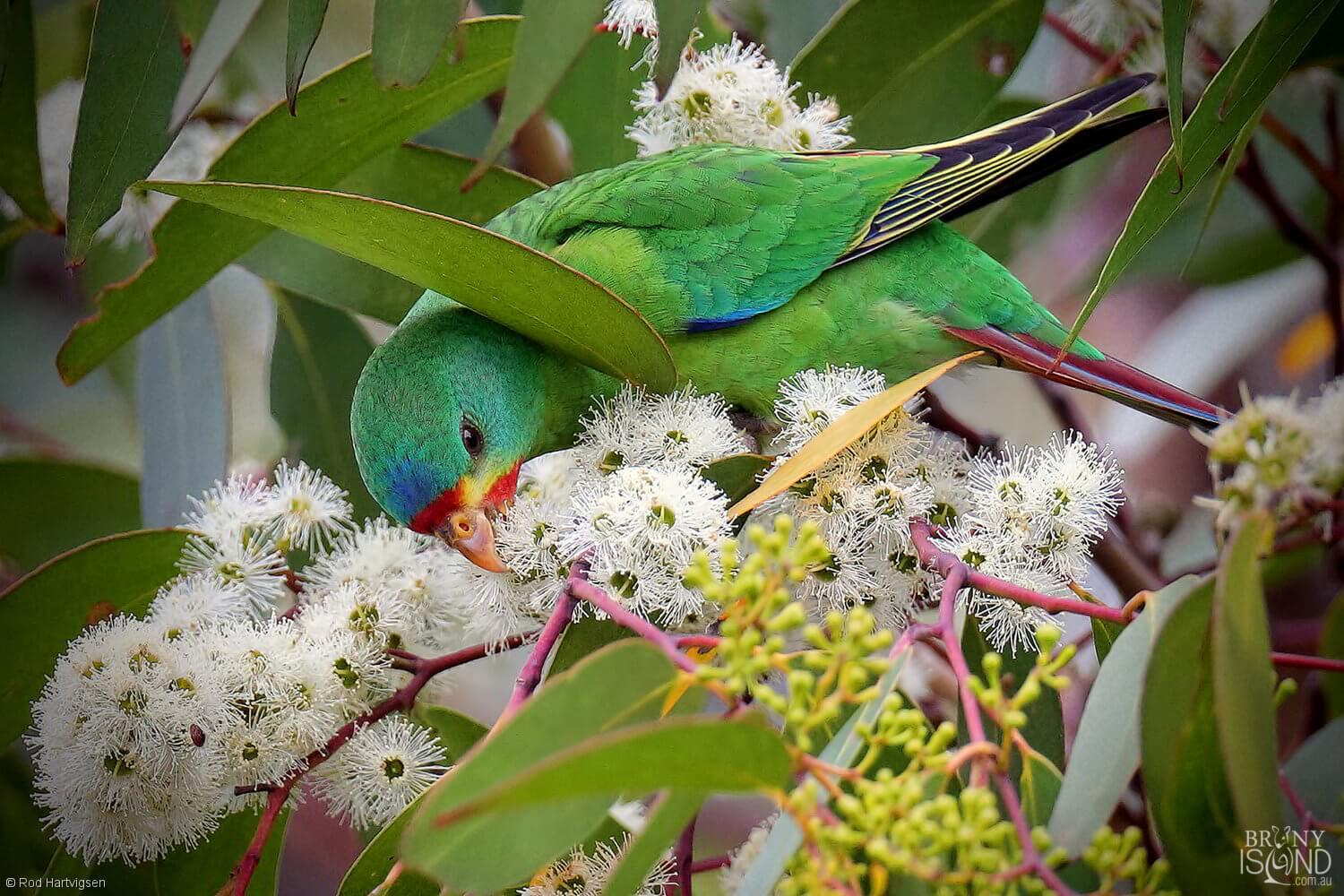
In the podcast I mentioned that the Swift Parrot was an endling, but I misspoke. An endling is the last individual of a species.[^ It’s also a game in which you play as the last fox mother.] The Swift Parrot is, I meant to say, critically endangered. There are just 750 estimated to be remaining in the wild, and “unless the threats facing the species are rapidly assessed, and its habitat restored, there is a high likelihood the parrot will become extinct over the next 20 years” (Zoos Victoria).
To hear the Swift Parrot is a happy-sad thing.
Ha! I am meant to be flaunting how buoyant and out of the dark forest I am. And it’s true; I’m beaming. But there remains things I know, and perhaps you know too, that warrant a healthy kind of sadness.
Having wended my way out of the dark forest, I now squint back unto the city cast in harsh light. I’ve a sense as to the work I am called to do.
Things to look forward to in 2026:
- The School of Fox Wizardry™ // A nine-month program in which you will cultivate the wit, wisdom and wiles needed to flourish as a ‘thought leader’ in this new age of cheap intelligence. Be the one they turn to.™
- The Lantern Guild™ // If the school goes well, we may well get a guild for rogue wizards happening. Thieves’ guild vibes. A network of construct-aware independent consultants and complexity practitioners who collectively band together for wicked challenges and collective projects. Work magic.™
- The Ritual of Becoming™ // I intend to run two cohorts of a new and improved program next year. One per equinox, with a view of having you primed or ready come solstice. A program of catalytic mythopoetic development for adults who have outgrown goal setting, and who seek to court and step into a new chapter of life. Attend to your unfurling.™
- I might offer a couple of WYRD Walks™ in nature, co-hosted with friends.
- I’m also courting the idea of organising what we might call A WYRD Retreat™—an extended, multi-day container of quality deep time together.
My liberal use of trademark symbols is sincere-ironic, btw. It’s also part of tending to their manifesting; telling ‘truth in advance’ and alchemising enduring whimsy into something a little more real and realised.
It’s literally WYRD Work™—attending to that which becomes.
I’ll be sharing much more on this in the seasons and cycles to come.

Dr. Jason Fox will also have new and legendary keynotes, masterclasses and immersions for adult motivation and leadership development.
Change is everywhere, but I still find that many organisations approach this mechanistically (and reactively), with far too narrow a focus. These are times that demand for us to be alive, awake, and attuned to the adjacent possible—for only that which can change can continue.[^ Anecdotally, and with extreme bias, teams who quest tend to do much better than those who do not.]
Speaking of: both of my websites—foxwizard.com and drjasonfox.com—carry the unsettling aura of the dark forest. My January task is to bring these into new light.
Thank you for reading/listening/subscribing.
(ᴗ͈ˬᴗ͈)ꕤ.゚
This past half-decade dark forest cocoon-sabbatical chapter has been fruitful; much has now coalesced. A curse has—well, if not lifted, then at least—shifted. And I feel all the better for it.
I’ve many wishes for you as the Gregorian calendar clicks over. Mostly that you are safe and well, and that this new year might bring a deeper sense of community, kinship and courage. I suspect 2026 is going to be a tumultuous one.
I also wish for us all to cultivate a tenderness despite.[^ To borrow the words from one of the participants in The “Choose One Word” Ritual of Becoming.]
With much warmth,
Jason
Member discussion